
Will Social Security Be There When I Retire?
Let me tell you why this question keeps me up at night, too
I'm going to be honest with you about something most retirement writers won't say out loud.
I'm 63 years old. I'm planning to retire in November 2026. And the trust fund that pays my Social Security benefit is projected to be depleted in 2033 — about seven years after my retirement date.
Read that again, because it took me a minute to sit with it for the first time too.
I could file for Social Security right now. The day I turn 62, the door opens. I could walk in tomorrow and start collecting a check. But if I do, I take a permanent reduction of about 30 percent off my full benefit — for the rest of my life — because I'm claiming before my full retirement age of 67. That's the cost of claiming early.
And here's where the math gets really interesting. I've spent decades helping other people understand exactly this kind of decision. I know the rules cold. I have saved quite a bit. I have other income streams in motion. I am, by any reasonable measure, prepared.
And it's still scary.
I want you to hear that, because I think a lot of women carry this fear privately and assume that everyone else has it figured out. They don't. I don't. The Social Security question is genuinely scary even when you've done everything right, because the timing of my retirement and the timing of trust fund depletion are landing in roughly the same window. I'll have a few years of full benefits, and then — if Congress does absolutely nothing — I'm looking at the same 23 percent cut everybody else is.
So, when women write to me asking, "Will Social Security be there when I retire?" — I'm not answering that question from above the problem. I'm answering it from inside the problem. Right alongside you.
That's why I want to walk you through this carefully. Not because I have all the answers, but because the answers I do have are the ones I'm using for myself.
The question landing in my inbox every single week
Every week — every single week — some version of this question shows up in my inbox: "Will Social Security even be there by the time I retire? Should I claim early before they cut it? Should I just assume it's gone and plan around zero?"
I get it. The headlines are alarming. The Trustees Report is real. The math is genuinely difficult. And for women specifically — who live longer, earn less, and rely on Social Security more heavily than men — the stakes are higher than for almost anyone else in this country.
So, I'm not going to tell you to stop worrying. I'm going to tell you to stop worrying blindly — and start planning precisely.
Here's what I've watched happen, year after year, and it's the part nobody in financial media wants to say out loud: women who let fear drive their Social Security decisions make worse choices than women who make no decision at all. They claim early. They underestimate how long they'll live. They blow past spousal and survivor benefits without optimizing them. They leave tens of thousands of dollars on the table over a retirement that could easily last 30 years.
The anxiety is reasonable. The response to that anxiety has to be grounded in what the data actually says — not what the morning news made it sound like over your coffee.
So, let's actually look at the facts together. The legislative history. The risks. And — most importantly — the concrete steps you can take right now to protect yourself under any scenario Congress eventually produces.
Related Reading: If you want a broader foundation before diving in, start with How to Plan for Retirement as a Woman Today. Then come back here, because what follows is the most important piece of the puzzle.
What the 2025 Trustees Report actually says
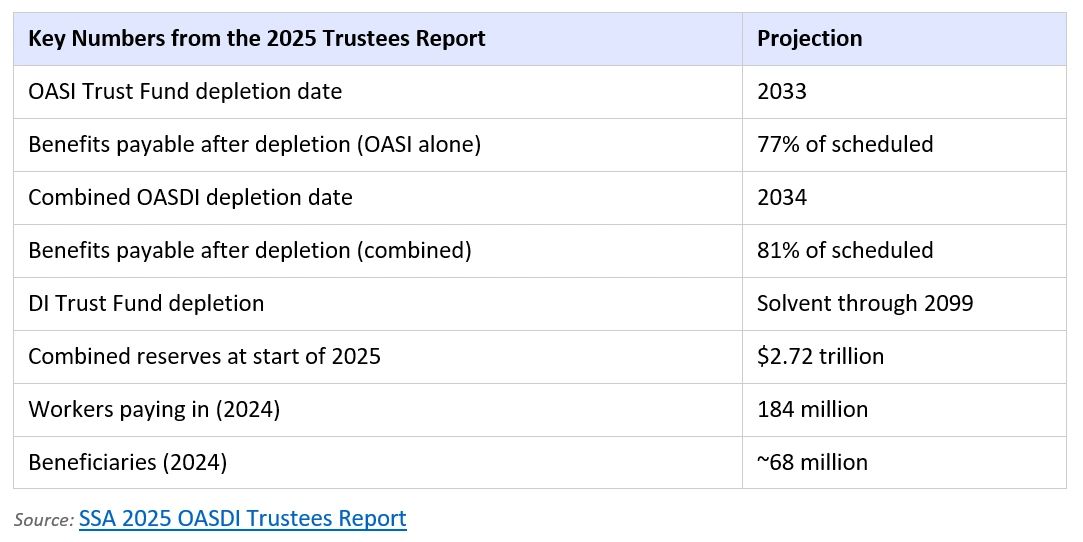
Let me walk you through the 2025 Social Security Trustees Report carefully, because most of what people believe about it is either incomplete or just wrong. The report, released in June 2025, delivers two numbers every woman approaching retirement should know by heart.
First: The Old-Age and Survivors Insurance (OASI) Trust Fund — the fund that covers your retirement and survivor benefits — is projected to be depleted in 2033. At that point, ongoing payroll tax revenue will be sufficient to pay 77 percent of scheduled benefits.
Second: If you look at the combined OASDI fund (which includes Disability Insurance), depletion is projected for 2034, at which point 81 percent of benefits would be payable from continuing income.
Now here's what the headline doesn't tell you: Social Security does not go to zero. It goes to 77 cents on the dollar. That's a critical distinction.
The trust fund is a reserve account — a buffer built up over decades when payroll tax revenue exceeded what was needed to pay benefits. As the baby boomer generation retires, and as the ratio of workers to retirees shrinks (from roughly 2.7 today toward 2.3 by the mid-2030s), that reserve is being drawn down. When the reserve is gone, the program does not stop. It continues paying benefits from the payroll taxes still flowing in from 184 million working Americans. What changes is the gap between what was promised and what can be funded without reform.
A 23 percent reduction in benefits is not comfortable. I won't pretend otherwise — I'm staring at the same possibility for my own retirement. But it's manageable, particularly if you know it's coming and plan accordingly. The 2033 projection is a problem with known dimensions and known solutions. That's a very different thing from a crisis with no path forward.
Why this matters more for women than anyone else
I've watched the Social Security debate play out in Washington for a long time and let me be plain about it: the women in this country have the most to lose from delayed planning, and the least margin for error. The data on this is unambiguous.
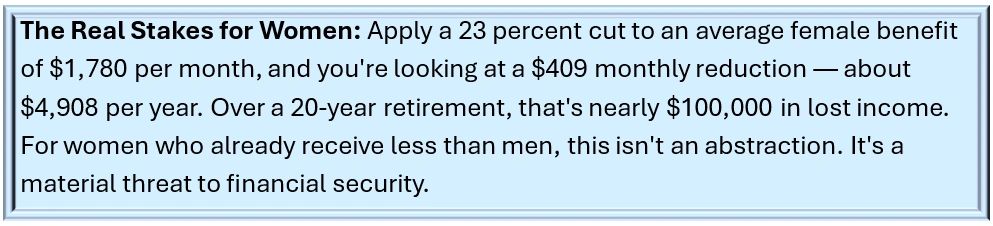
Per the SSA Fast Facts & Figures 2025, men collecting retired-worker benefits receive an average of $2,181 per month while women average $1,780 — about 82 cents on the dollar. That gap directly mirrors the wage gap, because Social Security benefits are calculated on lifetime earnings. Women who took time out of the workforce to raise children, care for aging parents, or support a spouse's career pay for those decisions twice: once in lost wages, and again in reduced benefits decades later.
And then there's the longevity factor. Women live longer than men — on average, several years longer — which means Social Security isn't just income for women. It's our most powerful longevity insurance. A guaranteed, inflation-adjusted benefit that cannot be outlived, cannot be lost in a market crash, and does not depend on a portfolio balance.
About 15 percent of women age 65 and older rely on Social Security for 90 percent or more of their income, compared to 12 percent of men. For those women, Social Security cuts aren't a line-item adjustment. They're a crisis.
Worrying without action is just suffering on an installment plan. So, let's keep moving.
Related Reading: If you're a single woman navigating this question without a spouse's income to fall back on, this conversation gets even more urgent. Read Financial Planning for Single Women for a framework built specifically for your situation.
What Congress can and cannot do
Here's the piece of history I come back to every time the Social Security debate heats up: in 1983, Social Security was approximately four months away from being unable to pay full benefits. The Greenspan Commission — a bipartisan panel convened by President Reagan — produced a reform package that Congress passed and the President signed. It raised the full retirement age gradually from 65 to 67. It made a portion of Social Security benefits subject to income tax for higher earners. It accelerated a scheduled payroll tax increase. And it extended coverage to federal employees. The program was stabilized for decades.
Congress has done it before. Congress will do it again. The question isn't whether Social Security will be reformed — it's when, and in what form. Here are the primary options currently on the legislative table, and what each would mean for women specifically.
Raising the payroll tax cap. In 2026, payroll taxes are assessed only on wages up to $184,500. Earnings above that threshold are exempt entirely. Lifting or eliminating this cap would require higher-income workers to pay more into the system. For the vast majority of women — who earn below the cap — this change would have zero personal cost and significant benefit to the program's solvency.
Increasing the Full Retirement Age. Raising FRA from 67 to 68 or 69 would effectively reduce lifetime benefits for everyone. For women — who live longer and rely more heavily on Social Security — this is among the most painful possible reforms. It's politically popular with some fiscal hawks and deeply unpopular with labor advocates.
Reducing cost-of-living adjustments. Proposals to shift from the current CPI-W to a chained CPI would reduce annual benefit increases by about 0.3 percentage points per year. Over a 25-year retirement, that compounds into a meaningful reduction in purchasing power. Again, women's longer lifespans make this disproportionately costly for us.
Means-testing benefits. Some proposals would reduce or eliminate benefits for higher-income retirees. Because women have lower average benefits and savings to begin with, means-testing at reasonable income thresholds would have less impact on women than on men — but the administrative complexity and political resistance are both formidable.
The key message I want you to take from this section: the system will be fixed. It's a mathematical problem and a political problem, and both of those are solvable. The 2033 deadline creates the kind of pressure that has historically been sufficient to force action.
But you need a backup plan that works whether Congress acts in 2027 or 2032 — because you do not get to pause your retirement while they deliberate. I know this because I'm not pausing mine.
How to plan as if Social Security pays 77 cents on the dollar
This is where I shift from context to action, because information without a plan is just anxiety with better footnotes. If you're asking yourself whether Social Security will be there when you retire, the honest answer in 2026 is: yes — but it may be smaller. Here's how to build a retirement plan that works in both scenarios. It's the same exercise I've run for myself.
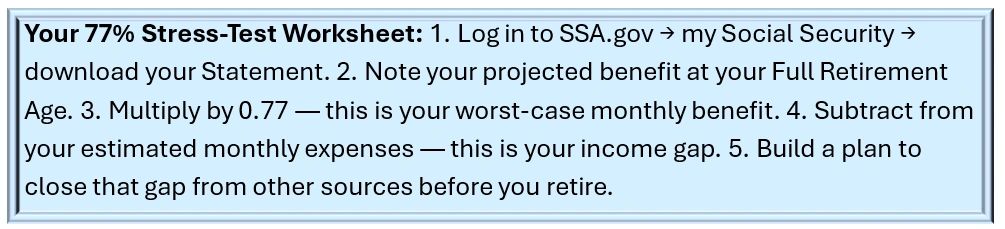
Step one: get your actual numbers. Go to SSA.gov and create or log in to your Social Security account. Download your Social Security Statement. This document shows your projected benefit at age 62, at your Full Retirement Age, and at age 70, based on your actual earnings history. These are your baseline numbers before any potential reduction.
Step two: apply the 77 percent scenario. Multiply your projected monthly benefit at each claiming age by 0.77. Write those numbers down. This is your stress-test scenario — the income floor you need to plan around if Congress takes no action before 2033. If your projected benefit at FRA is $1,800/month, your 77 percent scenario is $1,386/month. What's your monthly income gap? What savings, investment income, or other guaranteed income would cover that difference?
Step three: identify your gap and build toward it. The goal isn't to panic about a $409/month difference. The goal is to know, with precision, how much supplemental income you need to generate from other sources — and then build those sources systematically. I cover this in detail in Income Streams That Outlive Your Career, but the principle is straightforward: every dollar of guaranteed income you build outside of Social Security reduces your exposure to whatever Congress eventually decides.
Here's what I've learned from this work: women who run this exercise are almost always surprised by one of two things. Either the gap is smaller than the fear made them believe — and that's clarifying. Or it's larger than they expected — and that's galvanizing. Either way, they're better off knowing. Planning for 77 percent isn't pessimism. It's the professional standard I apply to every conversation I have, and the one I've applied to my own retirement plan.
The claiming strategy women cannot afford to get wrong
I want to address claiming strategy directly, because this is where I see the most preventable damage done to women's retirement security. The decision of when to claim Social Security is one of the highest-value financial decisions you'll ever make — and it's almost entirely irreversible.
You can begin claiming Social Security retirement benefits as early as age 62, but doing so permanently reduces your monthly benefit. Your Full Retirement Age (FRA) is 67 if you were born in 1960 or later. For every year you delay claiming beyond FRA — up to age 70 — your benefit grows by 8 percent. The result: delaying from age 62 all the way to 70 increases your monthly benefit by approximately 77 percent. For a woman with a projected FRA benefit of $1,800/month, that's the difference between $1,260/month at 62 and $2,232/month at 70. Every single month. For the rest of her life. Indexed to inflation.
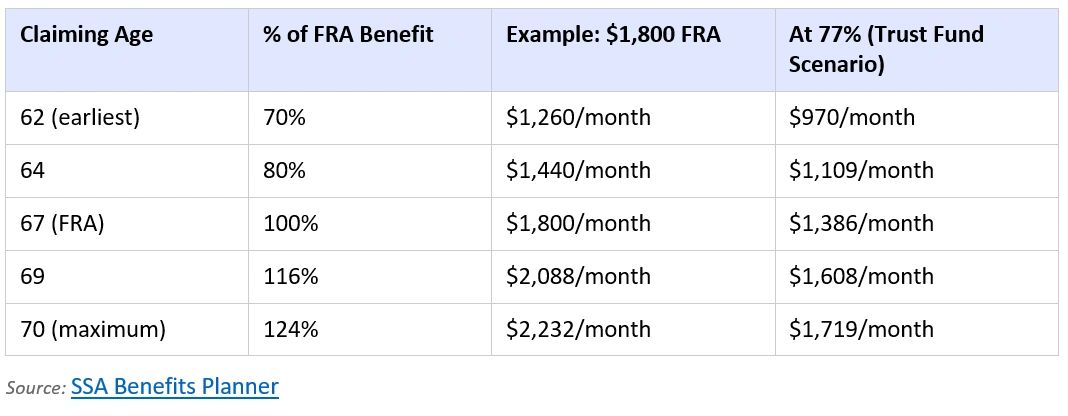
This is the chart that shaped my own decision. I'm not claiming at 62, even though I could. The math doesn't favor it for me — and frankly, doesn't favor it for most women. For women who live to 85 or beyond — and statistically, many of you will — delaying to 70 is almost always the mathematically superior choice. The break-even point (where total lifetime benefits from delayed claiming exceed total lifetime benefits from early claiming) typically falls around age 80 to 82. If you live past that age, every month beyond it represents money you would have left on the table by claiming early.
Now let me address the benefits that are least understood and most important for women: spousal, divorced spouse, and survivor benefits.
Spousal benefits. If you're married, you may be entitled to up to 50 percent of your spouse's FRA benefit — whichever is higher, your own earned benefit or the spousal benefit. This is particularly valuable for women who spent years out of the workforce and have lower earned benefits.
Divorced-spouse benefits. If your marriage lasted at least 10 years and you have not remarried, you may claim a benefit based on your ex-spouse's earnings record. Your ex doesn't need to know, consent, or be affected in any way. This is a right, not a favor.
Survivor benefits. This is the benefit I spend the most time explaining, because it's the one women most often discover only when it's too late to optimize. When a spouse dies, the surviving spouse inherits the higher of the two benefits. This means the higher earner's claiming decision determines the survivor benefit — often for decades. If your husband claims early at 62 and dies at 68, you inherit his reduced benefit. If he delays to 70, you inherit his maximized benefit. This single decision can shape a widow's financial security for 20 or more years.
Related Reading: Social Security claiming decisions intersect directly with your tax situation in retirement. Read The Retirement Tax Playbook for Women to understand how benefit timing affects what you owe — and how to minimize that exposure.
Building your Social Security backup plan

I'll say it plainly: Social Security is the foundation of retirement income for most American women, but it was never designed to be the whole house. Whether or not Congress reforms the program before 2033, every woman within 15 years of retirement should be actively building income sources that reduce her dependence on Social Security as a single point of failure. Here are the four strategies I come back to most consistently — and yes, the ones I've leaned on for myself.
Maximize your Roth accounts — aggressively. Roth IRA and Roth 401(k) contributions grow tax-free and are withdrawn tax-free in retirement. That matters beyond the obvious reason: Roth distributions don't count toward the provisional income threshold that determines how much of your Social Security benefit is subject to federal income tax. In other words, Roth income helps you keep more of every Social Security dollar you receive. If you're still in the workforce, every dollar you can shift into Roth accounts is doing double duty — building your backup income and protecting your Social Security from unnecessary taxation.
Build dividend income from quality equities. A portfolio of dividend-paying stocks or dividend-focused funds can generate quarterly income that grows over time, doesn't expire, and provides inflation protection. I'm not talking about chasing high-yield stocks with shaky fundamentals. I'm talking about a disciplined, diversified dividend income strategy that produces reliable cash flow during the years between retirement and Social Security claiming — or that supplements Social Security throughout retirement. The key is starting earlier than feels necessary.
Consider annuities for guaranteed lifetime income. I know the word "annuity" makes some women's eyes glaze over and others' shoulders tense up, and I understand both reactions. There are bad annuity products and there are good ones. A straightforward single-premium immediate annuity (SPIA) or a deferred income annuity from a highly rated insurer can provide a predictable monthly income floor that — like Social Security — can't be outlived. For women without a pension, a modest annuity allocation can provide longevity insurance the rest of the portfolio cannot guarantee. Think of it as buying your own pension with a portion of your savings.
Delay Social Security claiming as long as your health and finances allow. I addressed this earlier, but it bears repeating in the context of backup planning: the single highest-return, lowest-risk "investment" most women can make is delaying their Social Security claim. Every year of delay from FRA to 70 earns you an 8 percent permanent, inflation-indexed, longevity-protected increase. No bond pays that. No CD pays that. Bridging the gap from retirement to age 70 using savings, part-time work, or other income — and then claiming the maximized benefit — is often the most powerful retirement optimization available to women without a pension.
Related Reading: Building multiple income streams takes a clear architecture. Explore the full framework in Income Streams That Outlive Your Career.
Frequently Asked Questions
Will Social Security really run out by 2033?
No. The Old-Age and Survivors Insurance Trust Fund — the reserve account — is projected to be depleted in 2033. But ongoing payroll taxes from 184 million working Americans will continue flowing in, sufficient to pay 77 percent of scheduled benefits even with no congressional action. Social Security does not stop. It would pay reduced benefits unless and until Congress reforms the program.
How much will my Social Security check be cut if Congress does nothing?
If the OASI trust fund is depleted in 2033 with no legislative action, scheduled benefits would be reduced to about 77 percent of what was promised — roughly a 23 percent cut. For an average female benefit of $1,780/month, that's a reduction of about $409/month, or nearly $5,000 per year.
Should I claim Social Security early because of the cuts?
Almost never. Claiming early permanently reduces your benefit by up to 30 percent. If a 23 percent across-the-board cut hits in 2033, claiming early stacks two reductions on top of each other and locks in the lower benefit for life. Most women who live past age 80–82 come out further ahead by delaying — even with a potential trust fund cut factored in. Run your own numbers, or work with a fiduciary advisor who will.
What is the Social Security wage cap and how could changing it help?
In 2026, payroll taxes apply only to the first $184,500 of earnings. Income above that is completely exempt. Lifting or eliminating that cap would require higher-income workers to pay more, and according to most actuarial estimates, this single change could close most or all of the projected 75-year shortfall. The vast majority of women earn below the cap, so this reform has zero personal cost for most of us.
What's the most important Social Security decision a married woman can make?
Coordinate the claiming strategy between spouses with survivor benefits in mind. When one spouse dies, the survivor inherits the higher of the two benefits. If the higher-earning spouse claims early at 62, that reduced benefit becomes the survivor's income for the rest of her life. If the higher-earning spouse delays to 70, the survivor inherits the maximized benefit. This single decision can shape a widow's financial security for 20 or more years.
The bottom line: it will be there. Plan as if it might be smaller.
After all this — the Trustees Report, the women's gap, the claiming math, the reform options — I want to leave you with the clearest possible answer to the question.
Yes. It will be there.
Social Security is not disappearing. It's backed by the payroll taxes of 184 million working Americans. It's the most politically protected program in the federal budget. And it has survived every fiscal crisis and partisan battle in the last century without reducing a single scheduled benefit for existing retirees. The question of whether the trust fund will be fully solvent in 2033 is a real question. The answer, if Congress does absolutely nothing, is that benefits would be reduced to 77 cents on the dollar from ongoing tax revenue — not zero. Not eliminated. Reduced.
And Congress will almost certainly do something. The political cost of allowing an across-the-board benefit cut in an election cycle is extraordinary. The Greenspan Commission of 1983 proved that bipartisan reform is possible when the deadline is real. The 2033 deadline is real. Every year that passes without action increases the pressure for a solution.
But here's what I will not do: tell you to wait for Congress to act before you plan. Women who pause their planning while waiting for an answer are gambling with their most important financial asset. The women I've watched navigate retirement with grace and security aren't the ones who predicted exactly what Congress would do. They're the ones who built a plan that worked across multiple scenarios — and then adjusted as clarity emerged.
I started this article telling you I'm 63, planning to retire in November, and quietly nervous about a trust fund that's projected to run out about seven years later. All of that is still true. The fear doesn't disappear because you understand the data. But the data gives you something fear can't: a plan you can actually execute.
Run your 77 percent stress test. Know your numbers. Optimize your claiming strategy. Build your backup income streams. And do it now — while you still have time to make the decisions that matter most.
I'm doing it. So can you.
Related Reading:
• How to Plan for Retirement as a Woman Today
• The Retirement Tax Playbook for Women
• Income Streams That Outlive Your Career
• Financial Planning for Single Women
• Funded Contentment: The Retirement Goal Women Actually Need