
Long-Term Care: The Cost Women Cannot Afford to Ignore

The conversation nobody wants to have until it's too late
Let me start with a pattern I've watched play out so many times I could draw it from memory.
A woman does everything right. She works for decades. She puts away as much as the system would let her. She pays off her house. She walks into retirement feeling like she finally made it. Then her husband gets sick. She becomes his caregiver — for two years, four years, sometimes longer. She drains their joint savings to keep him comfortable. She loses her own working years to be the person who shows up every day. Then he passes. She grieves. And just when she thinks she might rebuild some kind of life, her own body starts giving out. She needs care. There's no spouse to help. The kids have their own lives. The savings are mostly gone.
And that's the woman who did everything right.
I'm not telling you this to scare you. I'm telling you because the story I just described isn't rare. It's the most common retirement disaster I see, year after year, and almost nobody plans for it. We plan for stock market crashes. We plan for Social Security claiming. We obsess over Roth conversions. And then one day a stroke or a fall or a diagnosis arrives, and the whole carefully built retirement evaporates in 24 months.
Here's the math that ought to wake you up. According to the Administration for Community Living, 70 percent of people turning 65 today will need some form of long-term care before they die. For women, the number is sharper: 53 percent of women will need long-term care, compared to 47 percent of men — and we'll need it for longer. And LIMRA estimates that only about 3 percent of Americans over 50 carry any form of long-term care insurance.
That gap between need and preparation isn't an oversight. It's a financial emergency quietly building in the lives of millions of women who think Medicare will handle it, or family will handle it, or it just won't happen to them.
Spoiler: it will probably happen to you. And Medicare won't.
So let's actually talk about it.
Why long-term care is a women's problem (not a generic retirement problem)
Every retirement article you've ever read mentions long-term care as a "risk." Most of them treat it as gender-neutral. It is not. Long-term care is structurally, financially, and brutally a women's issue, and once you see why, you can't unsee it.
Start with the raw numbers. Per the Administration for Community Living, women need an average of 3.7 years of long-term care. Men need 2.2 years. That 17-month difference doesn't sound dramatic until you do the math: at 2026 prices, that's somewhere between $90,000 and $200,000 in additional exposure depending on the care setting. Women live longer, which means we're more likely to develop the chronic conditions and cognitive decline that drive the care need in the first place. Per the Alzheimer's Association, nearly two-thirds of Alzheimer's patients are women. That isn't an abstraction. That's a probability you should be planning around.
But here's the layer almost nobody puts on the table: women aren't only more likely to need care. We're more likely to give it first, unpaid, to a spouse who needs care before we do. I've watched this pattern play out so many times. A woman spends two to four years as her husband's primary caregiver. She's drawing down their joint savings. She's interrupting her own earning years. She's exhausting herself emotionally and physically. Then her husband passes. And then she needs care herself — alone, with depleted savings, and no one in the house to help.
That's the financial double jeopardy of being a woman in America. You give care first. Then you need it. With fewer resources left to pay for it.
The marital status piece compounds everything. Single, divorced, and widowed women face the steepest exposure of all because there's no spouse — even an ailing one — to provide informal support. If you're going through this chapter alone, the assumption that "someone will be there" isn't a plan. It's a wish. And wishes don't pay nursing home bills.
Related Reading: Don't let the caregiving years quietly erode your own retirement security. Read Don't Let Caregiving Steal Your Retirement.
What long-term care actually costs in 2026
I want you to stop and look at these numbers. Not skim them. Look at them. Because the gap between what most women think care costs and what it actually costs in 2026 is one of the most dangerous gaps in retirement planning today
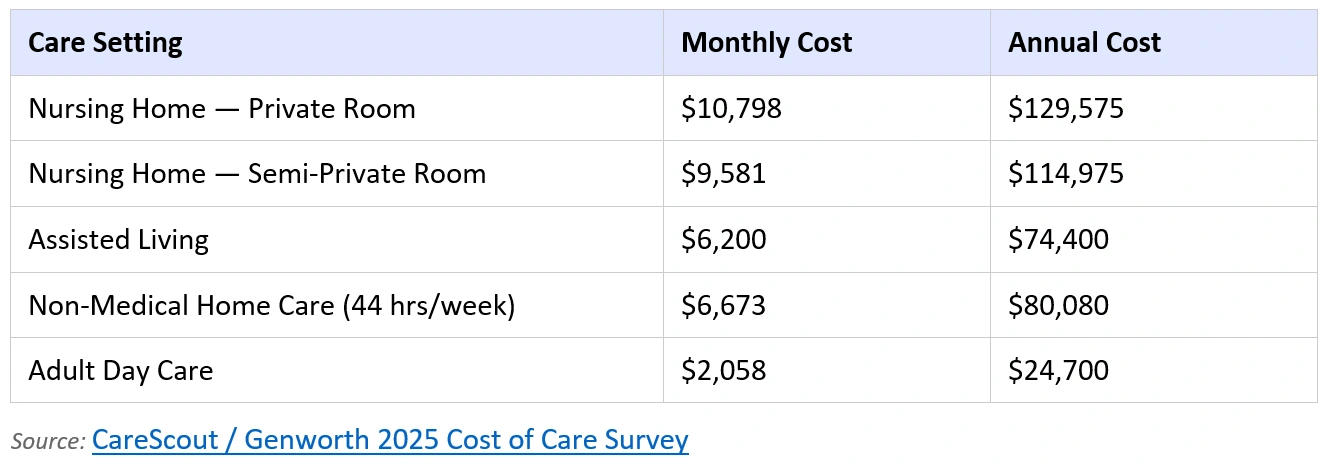
Now do the math with me. The average woman needs 3.7 years of care. At today's private-room nursing home rate, that's roughly $479,000. And that figure assumes prices freeze where they are right now, which they won't. Long-term care costs have inflated at about 3 percent per year historically — meaning costs roughly double every 24 years. So if you're 55 today and you need care at 82, the bill you're staring at is closer to double what's in that table.
Three years in a nursing home at 2026 rates costs nearly $390,000. Not $39,000. Three hundred and ninety thousand. For a woman who retires with $400,000 in savings — a perfectly reasonable, responsibly built nest egg — a single long-term care event can wipe out an entire lifetime of work in fewer years than it took her to build it.
Read that sentence again.
That's why long-term care planning isn't optional. It's the foundation that every other part of your retirement plan either stands on or crumbles into.
Related Reading: Building income that outlasts your working years takes a strategy. Read Income Streams That Outlive Your Career.
The Medicare myth that's costing women everything

Here's the most expensive assumption a woman can make about retirement: that Medicare will cover her long-term care.
It will not. And I'm not saying that as a caveat. I'm saying it as a hard, unambiguous fact that you need to internalize before you build any other piece of your plan.
Here's what Medicare actually covers. Skilled nursing facility care for up to 100 days, but only after a qualifying hospital stay of at least three days, and only for skilled nursing services like wound care, physical therapy, or IV medications. Medicare does not cover custodial care — the bathing, dressing, eating, and getting around that makes up the vast majority of what long-term care actually is. After day 20, Medicare wants a copay. After day 100, Medicare pays nothing. Zero. Doesn't matter if you still need care.
Your employer health plan doesn't cover long-term care either. Your retiree plan doesn't. Private health insurance doesn't. This isn't a loophole — it's how the American healthcare system was designed. Long-term care has always sat outside the insurance most people assume will protect them.
That leaves two real funding sources: long-term care insurance, and Medicaid. We'll get to both. But first, please absorb this: the coverage you've been counting on does not exist.

Related Reading: Medicare's gaps go deeper than most women realize. Read Medicare Has an Age Gap That's Costing You Everything and The Medicare Part B Trap.
Medicaid long-term care: the safety net with strings
Medicaid is the largest single payer of long-term care in this country. For millions of Americans, it's how nursing home care ultimately gets funded. But please hear me on this: Medicaid is not a plan. It's a last resort. And it's a last resort with conditions that most middle-class women are completely unprepared for.
To qualify for Medicaid long-term care in most states in 2026, you have to spend down your countable assets to roughly $2,000. That's not a typo. Two thousand dollars. That means liquidating your savings accounts, your investment accounts, and in many states, your home equity, until you are — by legal definition — impoverished. The house you paid off. The IRA you spent 30 years building. Gone. Spent on care before Medicaid pays a dollar.
Then there's the five-year look-back rule. When you apply for Medicaid, the program reviews every financial transaction you made in the 60 months before your application. Gifts to children or grandchildren, property transferred at below-market value, certain trusts — all of it can trigger penalty periods during which Medicaid won't cover your care, even if you've already spent down to the asset limit. The penalty period kicks in when you're already in a facility and already broke. I've watched this destroy families who thought they were being smart and proactive.
If you want to preserve any kind of legacy for your children or grandchildren, Medicaid planning requires a real elder law attorney and a head start of years, not months, before care is needed. The strategies exist. They just don't exist in a crisis.
If Medicaid ends up being your only option, work with a professional. But understand clearly: this isn't a path to protecting your assets. It's a path to accessing care after your assets are already gone.

Long-term care insurance: what it is and what it costs
Traditional long-term care insurance is a standalone policy that pays a daily or monthly benefit when you can no longer perform a certain number of activities of daily living — usually two of six — or when you have a cognitive impairment like Alzheimer's. Before you shop policies, understand the four terms that drive everything.
Daily or monthly benefit amount is the maximum the policy pays per day or month. A $200/day benefit, for example, would cover part of a $355/day private room.
Benefit period is how long the policy pays — typically two, three, or five years, or lifetime. Since women average 3.7 years of care, three years is a reasonable minimum.
Elimination period is the waiting period — usually 90 days — during which you pay everything out of pocket before insurance kicks in. Think of it as a giant deductible. You need liquid savings to cover it.
Inflation protection is the most important rider on the policy. A 3 percent compound inflation rider keeps your benefit growing alongside long-term care costs in the years between when you buy and when you need it. Skip this rider and you'll watch your coverage shrink in real terms every year.
Now, what does long-term care insurance for women actually cost in 2026? Here's what a $165,000 benefit policy with 3 percent compound inflation looks like, per the American Association for Long-Term Care Insurance 2025 Price Index:

A 55-year-old woman pays nearly 70 percent more than a 55-year-old man for the same coverage — because women statistically use the benefit more often and for longer. Welcome to one more direct financial consequence of the longevity gap. It's also one more reason long-term care insurance for women deserves its own conversation, not a generic one.
The optimal buying window is between 55 and 65. Here's why timing is everything: per AALTCI, nearly half of applicants over age 70 are declined by insurers. Your health at the moment you apply is what determines whether you qualify, not your age alone. Every year you wait is another year for a new diagnosis — diabetes, hypertension, an early cognitive concern — to price you out of the market entirely or disqualify you outright. Waiting is a gamble. And the house, in the form of healthcare costs, almost always wins.
Related Reading: Medicare income surcharges can affect how you fund long-term care premiums. Read Who the Heck Is IRMAA?.
Hybrid long-term care insurance: the option most women haven't heard of

The most common objection I hear when traditional long-term care insurance comes up sounds something like this: "What if I pay premiums for 20 years and never need it?"
Fair question. And hybrid long-term care insurance was built specifically to answer it.
A hybrid policy combines life insurance or an annuity with long-term care benefits built in. If you need care, the policy's death benefit or annuity value pays your care costs, often at an accelerated, amplified rate through a rider. If you never need care — or pass without using the full benefit — your heirs receive what's left as a death benefit or cash value. You're not "throwing away" premiums on coverage you never use. The money either pays for your care or passes to your family. That's it. That's the pitch.
Hybrid policies have become the most popular long-term care product on the market in the last decade for good reason. They solve the use-it-or-lose-it concern. They typically have fixed premiums that can't be raised — unlike traditional policies, which have seen ugly rate hikes over the years. And they can be structured with a single lump-sum premium or limited payments over 10 years, so you're done paying eventually instead of writing checks forever.
The tradeoff is they're generally more expensive upfront and may give you less long-term care benefit per dollar than a pure policy.
Hybrid long-term care insurance tends to make sense for women who have a lump sum available — from an inherited IRA, a rollover, a CD coming due — that they can reposition rather than pay ongoing premiums. It also works for women who want certainty that the money serves a purpose either way, and for those who are approaching the outer edge of the ideal buying window but are still in good enough health to qualify.
Traditional long-term care insurance gives you more coverage per premium dollar if you're young, healthy, and want maximum flexibility. The right answer depends on your specific assets, your health, your timeline, and your goals. A fee-only fiduciary advisor — not someone trying to sell you a policy — is the right person to help you model both options against your actual numbers. The National Association of Personal Financial Advisors maintains a searchable directory of fee-only fiduciaries.
Other ways to plan: self-funding and alternatives
Long-term care insurance isn't the only path. For women who can't qualify medically, who have enough assets to absorb a care event, or who are already past the optimal insurance buying window, alternatives exist. Here's what I've seen actually work.
A dedicated long-term care savings bucket. Set aside a separate, clearly labeled account — distinct from your general retirement savings — earmarked specifically for long-term care. This isn't a vague rainy day fund. It's a named reserve, invested conservatively or in liquid assets, that exists for one purpose. The psychological discipline of keeping it separate matters enormously. Women who comingle long-term care reserves with general savings consistently spend them down on other priorities before the care arrives.
Home equity strategies. Downsizing in your 60s can unlock real equity that becomes your self-funded care reserve. A Home Equity Line of Credit gives you a flexible credit line to draw on if needed. Reverse mortgages are a legitimate last-resort tool for homeowners 62 and older who've exhausted other options, but they carry significant costs and complexity that need careful independent review before you sign anything.
Health Savings Accounts. If you have access to an HSA through a high-deductible health plan during your working years, this is one of the most powerful and underused long-term care tools available. HSA funds can pay long-term care insurance premiums tax-free, up to IRS age-based limits, and can pay directly for qualifying long-term care services. A woman who maxes out HSA contributions in her 50s and invests them for growth has a triple-tax-advantaged care reserve waiting for her in retirement. Triple. Tax. Advantaged. This is the most quietly powerful tool in the box.
Continuing Care Retirement Communities. CCRCs — also called life plan communities — bundle independent living, assisted living, memory care, and skilled nursing into a single contract. You pay an entry fee (often $100,000 to $500,000 or more) and monthly fees in exchange for the assurance that your care needs will be met on-site as they evolve. For women who want certainty and community in one package, CCRCs can be a powerful solution. But they require real due diligence on the community's financial health and contract terms before you sign.
Family caregiving plans. Informal family caregiving is the most common form of long-term care in America, and one of the most personally and financially costly. If family members are part of your plan, that plan needs to be explicit, voluntary, and discussed openly — not assumed. More on that in the next section, because it deserves its own.
The family conversation nobody wants to have
I'll say this plainly: I've seen families destroyed not by the financial cost of a long-term care event, but by the complete absence of a conversation before the event happened.
Decisions made under crisis conditions — who provides care, where it happens, how it's funded, who has authority to act — are always more painful, more expensive, and more divisive than decisions made calmly, early, and on purpose.
Here are the questions that need answers before a crisis forces them.
Who makes decisions if I can't? A durable power of attorney names someone to manage your finances. A healthcare proxy or healthcare power of attorney names someone to make medical decisions. Without these documents, those decisions go to a courtroom. Don't let that be your story.
What does my healthcare directive say? Also called an advance directive or living will, this document records your wishes about life-sustaining treatment, resuscitation, and care preferences if you can't speak for yourself. It needs to be specific, current, and known to the people who will need to honor it.
Where do I want to receive care? Home? Assisted living near family? A CCRC you've already toured? These preferences need to be spoken aloud and written down. Don't make your family guess what you would have wanted.
Do my children understand the financial picture? If you have a long-term care plan, your family needs to know it exists. If you don't, your family needs to understand what a care event will require of them — financially and personally.
Is my will current and does my family know where to find it? This isn't a morbid question. It's a responsible one.
Have this conversation now, while it's uncomfortable but optional. The discomfort of a proactive family meeting lasts an afternoon. The cost of avoiding it can last years. I've watched it play out too many times to believe that love alone navigates a care crisis without a plan in place. Love is necessary. It's not sufficient.
Related Reading: Funded contentment, not fear, is the goal of retirement planning. Read Funded Contentment: The Retirement Goal Women Actually Need.
When to start: a decade-by-decade timeline

The best time to start planning for long-term care is always earlier than you think and later than you started. Wherever you are right now is the right time to take the next step. Here's what each decade looks like.
In your 40s. This is the awareness decade. Research the cost landscape so you understand what you're planning for. Check whether your employer offers any group long-term care benefit — a small but growing number of employers do, and group underwriting can make qualification easier. If you have access to an HSA, start maxing contributions and investing them for long-term growth. Your job in your 40s is to understand the risk and put it on your radar.
In your 50s — the sweet spot. This is the decade that determines your options. If you're going to buy traditional long-term care insurance, the window between 55 and 60 gives you the best combination of manageable premiums and high approval odds. Get quotes from multiple carriers. Work with a fee-only fiduciary advisor who specializes in women's retirement. Model the cost of a long-term care event against your projected assets. Don't let this decade pass without making a deliberate decision — even if that decision is a documented self-funding strategy.
In your 60s. If you don't have long-term care insurance by 62 to 65, your options narrow but don't disappear. Explore hybrid long-term care insurance, which often has more flexible underwriting. Build out your self-funding strategy on purpose. Start the family conversation. Research care options in your area — assisted living, CCRCs, home care agencies — so you're not researching from zero in a crisis.
In your 70s. The focus shifts from acquisition to protection and preparation. Make sure your legal documents — durable power of attorney, healthcare directive, will — are current, properly executed, and known to the right people. Review your asset structure with an elder law attorney if self-funding is your strategy. Identify and tour care facilities in your preferred area. The goal is to be prepared, not reactive.
Your three-step action plan: start here
I don't believe in ending an article with a problem and no solution. So here's where I want you to start. Three concrete steps in the next 30 days that move you from awareness to actually being prepared.
Step one: run your numbers. Understanding long-term care costs in the abstract is very different from understanding what a care event would specifically do to your retirement plan. Use the PROS+ Calculator to model a care event against your projected savings, income streams, and timeline. Seeing your actual numbers — not the national averages, but yours — is the single most powerful motivator for action I've ever seen in this work. Knowledge isn't frightening. Ignorance is.
Step two: get a real quote. Long-term care insurance premiums stay theoretical until you ask for a quote based on your actual age and health. Contact a fee-only financial advisor or a licensed long-term care insurance specialist who represents multiple carriers and has a fiduciary obligation to you, and ask for real quotes on both traditional and hybrid options. Don't make decisions based on general premium ranges. Get your actual numbers.
Step three: have the conversation. Schedule a real conversation — with your family, your advisor, and yourself — about what care looks like if you need it. Where do you want it? Who will advocate for you? What documents need to be in place? This conversation doesn't have to be long. It just has to happen. The single most important planning action most women can take right now has nothing to do with a financial product. It has to do with telling the people who love them what they want, while they still have the voice to say it.
Frequently Asked Questions
Does Medicare cover long-term care?
No. Medicare covers up to 100 days of skilled nursing care after a qualifying hospital stay, but it does not cover custodial care — the bathing, dressing, and daily help that makes up the vast majority of long-term care need. After day 100, Medicare pays nothing. This is the most expensive misconception in retirement planning.
How much does long-term care insurance cost for women in 2026?
Per the AALTCI 2025 Price Index, a 55-year-old woman pays about $3,750 per year for a $165,000 benefit policy with 3 percent compound inflation. The same policy at age 65 runs about $5,290 per year. Women pay roughly 70 percent more than men for identical coverage because we live longer and use the benefit more often.
What is the Medicaid five-year look-back rule?
When you apply for Medicaid long-term care benefits, the program reviews every financial transaction you made in the 60 months before your application. Gifts to children, property transferred at below-market value, and certain trusts can trigger penalty periods during which Medicaid won't cover your care, even if you've already spent down your assets to the $2,000 limit. Real Medicaid planning requires a head start of years, not months.
Is hybrid long-term care insurance better than traditional?
It depends on your situation. Hybrid policies solve the use-it-or-lose-it concern — if you never need care, the death benefit passes to your heirs. They also have fixed premiums that can't be raised. Traditional policies typically give you more long-term care benefit per premium dollar if you're young and healthy. Hybrid often makes more sense when you have a lump sum to reposition; traditional often makes more sense when you want maximum coverage flexibility.
When should I buy long-term care insurance?
The optimal window is between ages 55 and 65. Per AALTCI, nearly half of applicants over 70 are declined entirely. Your health at the moment you apply determines whether you qualify, not your age alone. Every year you wait is another year for a new diagnosis — diabetes, hypertension, an early cognitive concern — to price you out or disqualify you completely.
The bottom line
Long-term care planning isn't about fear. It's about love. Love for the life you've built. Love for the independence you've earned. Love for the people who would otherwise carry the weight of an unplanned crisis on their backs.
You spent decades building financial security. Spend the next thirty days protecting it.
Your future self is counting on you.
Related Reading:
• Medicare Has an Age Gap That's Costing You Everything
• The Medicare Part B Trap: Deadlines, Penalties, and the Income Rule
• Income Streams That Outlive Your Career
• Don't Let Caregiving Steal Your Retirement
• Funded Contentment: The Retirement Goal Women Actually Need