
Can Social Security Be Fixed? Yes — And Here's the Plan Nobody's Telling You About
Let’s just say the quiet part out loud: Social Security is not going anywhere. You’ve seen the headlines screaming that it’s about to vanish. The countdown clocks. The doom. And we need you to take a breath, because most of that noise is built to scare you, not to inform you. So let’s sit down and talk about it the way two grown folks talk over coffee. No panic. No jargon. Just the truth, and then a plan.
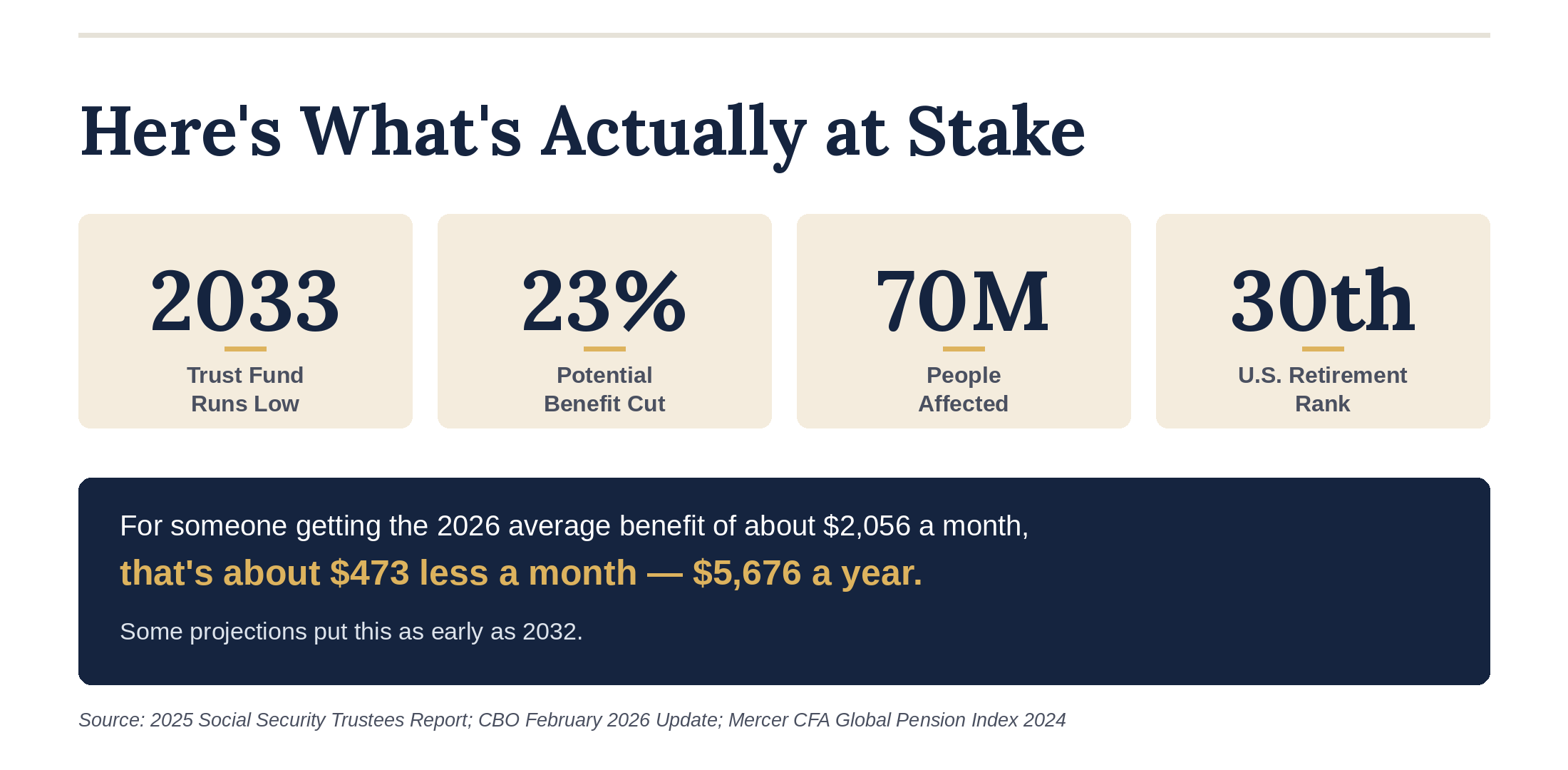
Here’s where things actually stand. The latest projections as of February 2026 say the retirement trust fund runs low somewhere around 2033, and one government estimate thinks it could come a year sooner, in 2032. But “runs low” does not mean “runs out.” Even if Washington did absolutely nothing — which would be a choice, and a bad one — the program would still pay about 77 cents on every dollar from the taxes still coming in. That’s a cut of roughly 23%. Real money, yes. But not zero, and not the end of Social Security. So let’s talk about how we make sure that cut never happens at all.
For most of us, Social Security isn’t a little bonus on the side — it’s roughly half of our retirement income. So when somebody shrugs and says “eh, it’ll sort itself out,” know this: they’re gambling with our grocery money.
So let’s not gamble. Let’s look for ways to find solutions that are fiscally responsible and economically viable. Let’s stop the debates on Capitol Hill about raising the retirement age or privatizing Social Security. We all know those solutions will not work and are not sustainable. Maybe it’s time for us to glean from other countries who have pension funds that are thriving. Maybe it’s time for us to make some tough choices. More importantly, it’s definitely time for us to come together as a country and be willing to solve the problem as a collective. Because if Social Security begins to pay $0.77 on the dollar by 2033, the time for us to come together would have come and gone.
So let’s think outside of the box and let’s look at what some other countries are doing to ensure the viability of their pension funds.
Why Are We the Only Ones Letting This Money Just Sit There?
Here’s a question almost nobody thinks to ask: why does the United States keep its entire Social Security trust fund — $2.72 trillion of it — parked in government bonds earning about 2.5% a year? No stocks. No real share in the economy that money helps build. Just sitting there, barely keeping up. Heck, inflation is sitting at 3.8% — meaning the fund is actually losing ground every year it sits where it sits. Imagine never investing a dollar of our own retirement and just letting it sit in checking for 50 years. We’d never do that to ourselves. So why are we doing it to the nation’s retirement?
The honest answer is part habit, part old law, and part fear of the word “stocks.” There’s a rule on the books that says the fund can only hold Treasury bonds. Changing it takes an act of Congress. But almost every other country with a national pension figured this out a long time ago — the money can be invested, carefully and professionally, through a board that runs separate and apart from the politicians. So the real question for us isn’t “is it possible?” We already know it is. The question is, what on earth is stopping us?
Look at Canada. Back in 1999, Canada set up an independent board to invest its national pension money, kept at arm’s length from the government and run by professionals. Last year that fund earned 7.8%. Today it’s worth more than $790 billion — and here’s the part that should stop all of us in our tracks: about 70% of that, nearly half a trillion dollars, came purely from investing, not from what workers paid in. The fund is so strong, Canada is now moving to lower the amount workers have to contribute. Read that twice. Their system is healthy enough to give workers a break. Meanwhile ours is treading water and we’re being told to brace for cuts.
And it’s not just Canada. Japan runs the largest retirement fund on the entire planet, around $1.7 trillion, with about half of it invested in stocks. Do the returns bounce around from one year to the next? Of course they do — that’s what markets do. But over the long haul, that patient approach is exactly why these funds keep growing. The goal was never to chase a hot year. It was to stop leaving decades of growth on the table — which is exactly what we’ve been doing.
Now, the fair question: does any of this actually help real people, or is it just big numbers on a page? It helps. When the fund behind the system is strong and growing, the system is secure — which means the checks we count on are secure too. Canada’s own actuaries confirmed their plan is sound for generations. That’s the whole point of putting the money to work instead of letting it sit: it protects the benefit, so the people leaning on it — our parents, our neighbors, and us when our turn comes — can breathe.
And to be clear, nobody is suggesting we gamble the rent money. A smart version keeps a big chunk safely in Treasuries for the checks going out next month, and invests the rest in plain, low-cost index funds — the boring kind — overseen by an independent board, not a politician worried about the next election. Boring is the goal. Boring is what grows.
Related Reading: Will Social Security Run Out? Here’s the Real Story — [confirm live URL]
Why Haven’t We Lifted the Payroll Cap?

Here’s another question worth sitting with: why does Social Security stop collecting from the highest earners partway through the year? In 2026, we pay Social Security tax on every dollar we earn up to $184,500. After that, the tax simply switches off. So somebody earning $184,500 pays all year long, every paycheck, January to December. But somebody earning ten times that stops paying sometime in the spring and coasts the rest of the year — tax-free, on the Social Security side. Lifting that cap — so everyone pays on all their earnings — could close most of the shortfall by itself, somewhere around $235 billion a year. So why on earth haven’t we done it?
The honest answer is a promise. Somewhere along the way the line in the sand became “no new taxes,” and lifting the cap gets slapped with the “tax hike” label. But let’s be real about who we’re actually talking about. Ninety-four percent of us already earn under that cap. We would see no change at all. None. We’re talking about the top 6%. And that 6%? A few extra dollars on income most of us will never come close to — and between you and me, that’s a group that knows exactly how to write it off.
This was never a tax on working people. It’s an old line that stopped keeping up. That cap covered 90% of all the wages earned in America back in 1983. Today it covers only about 83%, because incomes at the very top ran away from everybody else’s. Closing that gap isn’t punishing anyone. It’s just letting the rule catch up to the world we actually live in.
What If Everyone Got to Participate?
Here’s a truth almost nobody says out loud: we leave billions of dollars on the table every single year — and not because anybody’s cheating. We leave it because Social Security was built for a world that barely exists anymore. It was built for the W-2 economy — one job, one employer, one steady paycheck with the tax taken out automatically. It was not built for Etsy. It was not built for DoorDash, or Uber, or Lyft, or the millions of us piecing together a living in ways the system never imagined. Last year alone, 23 million Americans earned money through apps, and a huge share of it never made it into Social Security at all. Not because anybody dodged it. Because there was no door built for them to walk through.
So maybe it’s time we built one. Think about how this already works in other countries. When their citizens take part in the economy — when they buy something — a small slice goes to support shared programs, including the nation’s pension. Everyone participates, just by living their everyday life. And we already understand this instinctively: when we travel somewhere else and buy a coffee or a souvenir, we’re participating in that country’s economy too. The idea isn’t strange. It’s just one we’ve never extended to ourselves.
Now put the two facts side by side. We know that around 2033, without action, benefits could be cut 23% for 70 million people. And we know that something as small as buying a cup of coffee could help prevent it — six cents on a $6 cup, with groceries, medicine, the doctor, childcare, and school completely exempt. So the real question was never “should we raise something.” It’s this: knowing what’s at stake, wouldn’t we want everyone to have a way to take part?
And let me be straight, because I always am. Yes, this means a penny on the dollar at the register. I’m not going to dress that up. But it’s a penny that skips the things that keep us alive, it finally catches the whole modern economy that’s slipping through the cracks right now, and paired with a small cut to the tax already coming out of our paychecks, a lot of working people would come out ahead — more in our pockets and a stronger Social Security at the same time. That’s not a tax wearing a nicer word. That’s everyone finally getting to be part of the same system.
Put It Together, and the Math Just Works
Stack all three up, and we don’t just patch the hole — we build a cushion. Together they’d bring in somewhere between $307 and $463 billion a year, against a gap of $200 to $300 billion. That’s the problem solved with room to spare. No benefit cuts. Nothing new for 94% of us. And none of it is experimental — the United States currently ranks 30th out of 52 countries for retirement security. Fifty-one countries already figured this out. The only real question left is whether we will.
And notice what these three really have in common. Every one of them is about ending the same old habit: leaving things on the sidelines. Money that should be growing, but just sits there. Earners who stop paying in halfway through the year. Whole groups of workers the system never built a door for. Fix all three, and we’re not just saving Social Security — we’re letting everybody, and every dollar, finally take part.
And we are not nearly as alone in wanting this as the news makes us feel. In recent surveys, 71% of Americans backed a nonpartisan commission to fix Social Security, and a majority support lifting the cap. The public is way out ahead of Congress on this one. The hold-up was never the math. It’s the will. And that’s exactly where we come in.
So here’s what we do while Washington takes its sweet time. Build retirement income that doesn’t lean entirely on a check politicians haven’t protected yet. Learn how the system actually works, so nobody can ever scare us with half a story again. And make some noise with the people we vote for. You’ve got a whole lot more power than they want you to believe — and so do all of us, together.