
How Women Can Improve Financial Literacy for Retirement

The retirement industry did not fail women because women are bad with money. It failed women because it taught us the wrong curriculum.
Think about what most financial literacy looks like. Budgeting. Saving. Paying off debt. Those skills matter. But they are the equivalent of learning the alphabet. Retirement planning requires you to read entire novels in a language most women were never taught. Social Security timing strategies. Tax-advantaged account rules. Required minimum distributions. Medicare enrollment windows. Roth conversion math. These are the topics that determine whether you retire comfortably or run out of money at 82. And nobody puts them on the syllabus.
Here is what makes this urgent. The Transamerica Center for Retirement Studies found that women’s median retirement savings is $56,000 — barely half of men’s $92,000. Only 25 percent of women have a written retirement plan. And 27 percent of women expect Social Security to be their primary retirement income source. When your primary income source is a system with thousands of rules about timing, spousal benefits, survivor benefits, and tax treatment, not understanding those rules is not just a knowledge gap. It is a financial emergency.
This is your roadmap to close it.
The Five Retirement Knowledge Gaps That Cost Women the Most

These are not abstract concepts. Each one has a dollar amount attached to it, and every woman I talk to is dealing with at least two of them.
1. Social Security Timing
Social Security is not a switch you flip when you stop working. The age you claim changes your income for life. For women born in 1960 or later, claiming at 62 gives you just 70 percent of your full benefit — a 30 percent permanent cut. Waiting until 70 gives you 124 percent. That is a 77 percent difference between your smallest and largest possible check. For a woman with a full retirement benefit of $2,000 per month, the difference between claiming at 62 and 70 is over $12,000 per year, every year, for life. And yet nearly 30 percent of Americans still claim at 62, according to the Bipartisan Policy Center. Women claim slightly earlier than men on average, even though we live longer and need that income for more years.
2. Tax-Advantaged Accounts
The difference between a traditional 401(k) and a Roth 401(k) is not a detail. It is a decision worth tens of thousands of dollars. Knowing when to contribute pre-tax versus after-tax, when a Roth conversion makes sense, and how required minimum distributions work starting at age 73 or 75 under SECURE 2.0— this is the knowledge that separates a manageable tax bill from an overwhelming one. In 2026, the 401(k) limit is $24,500, or $32,500 with catch-up contributions if you are 50 or older. The IRA limit is $7,500 or $8,600. Every dollar you put in the right account at the right time is a dollar that works harder for you.
3. Healthcare Costs
Healthcare is the expense retirees underestimate the most, and it hits women harder because we live longer. Medicare enrollment has deadlines that carry permanent penalties — a 10 percent premium surcharge on Part B for every 12-month period you were eligible but did not enroll, and you pay that penalty for the rest of your life. The standard Part B premium is $202.90 per month in 2026. Miss your window by two years and you are paying 20 percent more on every premium check until the day you die. That is entirely avoidable with basic knowledge.
4. Investment Literacy
Women are often told we are “risk-averse” investors. In my experience, that is not true. Women are not risk averse. We are information deprived. When women understand their options and the time horizon involved, they make excellent long-term investors. But too many women stay in overly conservative allocations throughout their working years, accepting returns that do not keep pace with what they need. Understanding the basics of asset allocation and the role of equities over a 20-to-30-year retirement is not optional. It is how your money survives as long as you do.
5. Longevity Risk
Longevity risk is the risk of outliving your money, and it is fundamentally a women’s issue. We live approximately five to seven years longer than men on average. That means more years of retirement, more years of healthcare costs, a higher chance of needing long-term care, and a higher chance of being widowed and living on a single income. Planning for a 20-year retirement when you might live 30 is not pessimism. It is math.
Seven Ways to Close the Gap
Knowing the gaps is the first step. Closing them is where the real work happens. Here is what I recommend to every woman, whether you are 40 or 65.
1. Take a Retirement-Specific Course
General personal finance courses will not give you what you need. Look for courses that cover Social Security optimization, Medicare enrollment, retiree tax planning, and withdrawal sequencing. The Women’s Institute for a Secure Retirement (WISER) offers programs designed specifically for women. Many community colleges and libraries offer free workshops. You do not need to spend thousands of dollars. You need to find the right curriculum.
2. Read Your Social Security Statement
Go to ssa.gov/myaccount and look at your estimated benefits at 62, at full retirement age, and at 70. Calculate the difference. For many women, this single exercise is the most eye-opening financial moment they have ever had.
3. Understand Your Employer’s Plan
If you have a 401(k) or 403(b), schedule a meeting with your plan administrator. Ask about your vesting schedule, the employer match formula, whether your plan offers Roth contributions, and what your distribution options are. If you are within 10 years of retirement, this meeting is not optional.
4. Build a Real Retirement Budget
The “80 percent of pre-retirement income” rule of thumb is dangerously oversimplified. Your actual needs depend on your healthcare costs, your housing, whether you carry debt into retirement, and how long you expect to live. Build a detailed budget. Include inflation. Include healthcare premium increases. Be honest about what your life actually costs.
5. Learn the Tax Rules
Social Security benefits can be taxable. Traditional IRA and 401(k) withdrawals are taxed as ordinary income. RMDs can push you into a higher bracket. Roth conversions during low-income years can save tens of thousands over a retirement. IRS Publication 590 is free and explains the IRA rules in detail. Read it. It is not exciting, but it is worth real money.
6. Find a Fiduciary Advisor
A fiduciary is legally required to act in your best interest. Look for advisors with the CFP designation who operate on a fee-only basis — meaning they do not earn commissions on products they sell you. The NAPFA directory and the CFP Board’s Find a CFP tool are both good starting points. One consultation can change your entire retirement trajectory.
7. Learn in Community
Learning is easier when you are not doing it alone. WISER offers networks specifically for women navigating retirement. Online communities, local meetup groups, and women’s financial book clubs provide accountability and shared knowledge. When women talk openly about retirement money, everyone benefits.
Related reading: Financial Advisor for Women | How to Plan for Retirement as a Woman Today
Free Resources That Most Women Do Not Know Exist
One of the most common things I hear is “I do not know where to start.” So let me make it easy. Here are vetted resources, most of them completely free, that can help you start building your retirement knowledge today.
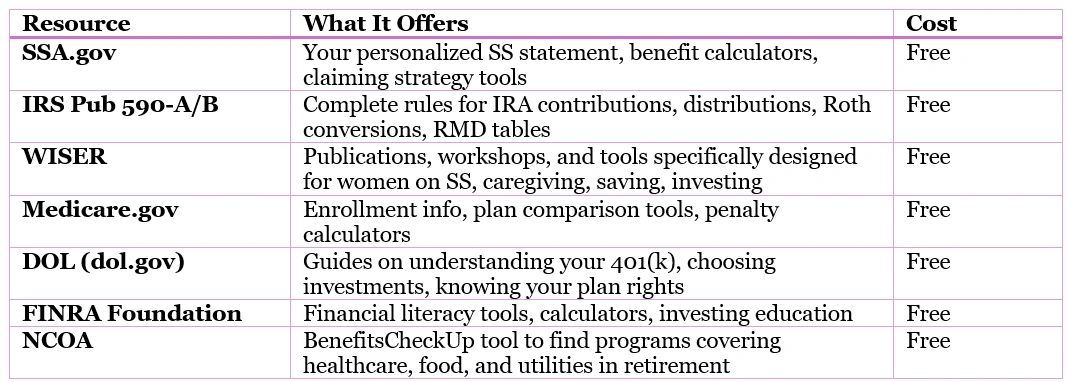
I want to highlight WISER in particular. They operate the National Resource Center on Women and Retirement in cooperation with the Administration for Community Living. Their materials are specifically designed for women, including lower-income women, women of color, and caregivers. It is one of the most underutilized resources available to women in America today.
Your 30-Day Retirement Literacy Plan
Knowledge without action is just trivia. Here is a week-by-week plan to start building your retirement knowledge. It works whether you are 35 or 65.
Week 1: Know Your Numbers
Create your my Social Security account and review your estimated benefits at 62, 67, and 70. Gather your 401(k), IRA, and pension statements. Calculate your total savings across all accounts. Write down your current monthly expenses — that is your baseline retirement budget starting point.
Week 2: Understand Your Benefits
Schedule a meeting with your employer’s HR or benefits department. If you have a pension, request a personalized benefit estimate. Read the Summary Plan Description for your retirement plan — this is the document that explains the rules governing your money. Determine whether your plan offers Roth contributions.
Week 3: Learn the Rules
Read IRS Publication 590-B — focus on RMD tables and Roth conversion rules. Visit Medicare.gov and review the enrollment timeline, including Initial Enrollment Period and Special Enrollment Period rules. Learn how Social Security benefits are taxed — up to 85 percent can be subject to federal income tax depending on your combined income.
Week 4: Build Your Team
Research fiduciary advisors through NAPFA or the CFP Board. Schedule at least one introductory consultation. Join a women-focused retirement or financial education group. And share what you have learned with one other woman in your life. When you teach it, you own it.
Frequently Asked Questions
Is it too late to start learning about retirement at 55 or 60?
Absolutely not. Many of the highest-impact retirement decisions, like Social Security timing, Roth conversions, and Medicare enrollment, happen in your late 50s and 60s. This is actually the most important time to learn because the decisions you make in the next few years will shape the next 25.
Why is retirement financial literacy different from regular financial literacy?
Regular financial literacy covers budgeting, saving, and debt. Retirement literacy covers a completely separate body of knowledge: withdrawal sequencing, tax bracket management, Medicare rules, RMD calculations, and Social Security optimization. You can be excellent at the first and completely unprepared for the second.
Do I need a financial advisor or can I learn this myself?
Both. A fiduciary advisor can model scenarios and catch mistakes you might miss. But understanding the basics yourself means you can ask better questions, evaluate the advice you receive, and make informed decisions rather than just following orders. The most powerful combination is self-education plus professional guidance.
What is the single most important thing I can learn?
How Social Security claiming age affects your income for life. For most women, this is the single highest-dollar decision they will make in retirement. The difference between claiming at 62 and 70 can be over $250,000 in lifetime benefits. Start there.
Your Retirement Literacy Is Your Power

The women who retire with confidence are not the ones who earned the most. They are the ones who learned the most. They understood Social Security timing. They managed their tax brackets. They enrolled in Medicare on time. They planned for long lives instead of hoping for the best.
You do not need a finance degree. You do not need to spend thousands on courses. You need curiosity, consistency, and the willingness to start. The resources exist. The knowledge is available. The only question is whether you will claim it.
Start today. Your future self is counting on you.
Your Next Step
Take the free PROS+ assessment at redefineyourretirement.org to identify the specific gaps in your retirement knowledge and your plan. Then explore the Retire Her Way blog for straight talk about every topic on this list.