Retirement Income Streams That Outlive Your Career
The retirement industry loves to talk about “the number.” Save $1.2 million. Save 10 times your salary. Save until your eyes cross and your soul leaves your body. And then what? You sit on a pile of money and pray it lasts 30 years?
No. That is not a plan. That is anxiety with a brokerage account.
The women I have watched retire with real confidence are not the ones with the biggest pile. They are the ones with the most layers. Multiple retirement income streams working together so that no single thing — not a market crash, not a health scare, not an HOA assessment you did not see coming — can knock them off their feet.
And here is the part the traditional playbooks skip: building retirement income for women requires a different strategy. The old model was simple. Work for 40 years. Collect a pension. Live on Social Security. That model is gone for most of us. Today, only about one-third of older adults receive a pension, with the median pension paying roughly $11,040 per year. The average Social Security benefit is about $2,071 per month in 2026 — roughly $24,850 per year. If you think that covers a comfortable life, I have some math I would like to show you.
The Bureau of Labor Statistics reports that retiree households spend an average of about $55,000 per year. The average income before taxes for a retired person is roughly $48,800. That is a gap. And gaps do not fix themselves. This guide is your blueprint for making sure that gap does not define your retirement.
The Income Layer Framework
Think of your retirement income like a building with four floors. Each floor holds weight on its own, but together they create something that can survive a storm. One floor gets damaged? The building still stands. That is what we are building here.
Layer 1: Guaranteed Income. Social Security, pensions, annuities. Money that shows up every month no matter what Wall Street is doing.
Layer 2: Investment Income. Dividends, bond interest, capital gains. Money your money earns while you sleep.
Layer 3: Earned Income. Part-time work, consulting, freelancing. Money you actively earn — on your terms, on your schedule, in your pajamas if you want.
Layer 4: Passive and Digital Income. Rental income, royalties, digital products, licensing. Money that flows whether you show up today or not.
The goal is not to max out every layer. The goal is to have enough layers that if one takes a hit, the others keep you standing. That is the difference between fragile and resilient. We are building resilient.
Layer 1: Guaranteed Income — Your Foundation
Guaranteed income is the floor beneath your feet. It should cover your non-negotiable expenses: housing, food, healthcare, utilities, insurance. If your guaranteed income handles the basics, everything you build on top of it is freedom.
Social Security
Social Security is the backbone of most retirement income plans, and for good reason. It is inflation-adjusted, government-backed, and it pays for as long as you breathe. There is nothing else like it.
But guaranteed does not mean maximized, and this is where a lot of women leave serious money on the table. The difference between claiming at 62 and claiming at 70 can be $100,000 or more over your lifetime. Let me show you the math.
A woman entitled to $1,800 per month at her full retirement age of 67:
Claims at 62? She gets $1,260 per month. That is a 30 percent permanent reduction. Not temporary. Permanent.
Claims at 67? She gets the full $1,800.
Waits until 70? She gets $2,232 per month. A 24 percent permanent increase.
The difference between 62 and 70 is $11,664 per year, every year, for the rest of her life. If she lives to 85, that is $174,960 she either collects or leaves behind. And women live longer than men, which means the math of waiting favors us even more.
I know waiting is not possible for everyone. Some women need the income at 62 and there is no shame in that. But if you have other income sources to bridge the gap, delaying Social Security is one of the smartest financial moves you will ever make.
Related reading: The Hidden Truth About Social Security
Annuities — Know the Difference Before You Sign Anything
Not all annuities are created equal, and that is putting it politely.
A Single Premium Immediate Annuity that gives you a pension-like check for life? That can be a smart move for a woman who worries about outliving her money. A Multi-Year Guaranteed Annuity for the conservative part of your portfolio? Solid. Think of it as a CD with better rates. A variable annuity with fees so high you need a magnifying glass to find your returns? Keep walking.
The key is knowing the difference, and the best way to know the difference is to talk to a fee-only advisor who does not earn a commission on what they recommend. That one conversation can save you tens of thousands of dollars.
My rule of thumb: never put more than 25 to 30 percent of your retirement savings into any annuity. You need liquidity for the unexpected, and the unexpected does not care about your surrender schedule.
Related reading: How to Build Wealth for Retirement: A Woman’s Guide
Layer 2: Investment Income — Your Growth Engine
.jpg)
This is the layer where your money clocks in for work so you do not have to. And before you tell me you are not an investor, let me stop you. If you have a 401(k), you are already an investor. We are just going to get more intentional about it.
Dividend Investing
Dividend-paying stocks distribute a portion of company profits to shareholders, typically quarterly. It is one of the most reliable ways to generate income without selling your investments. You keep the stock. The stock pays you. Repeat.
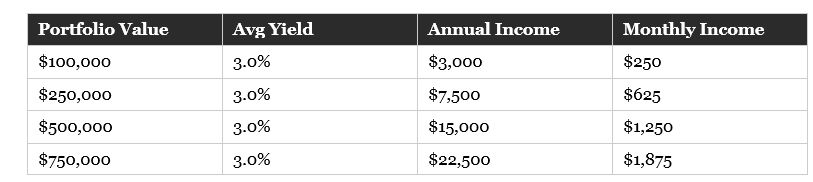
The Dividend Aristocrats are S&P 500 companies that have increased their dividend payments for at least 25 consecutive years. Twenty-five years. Through recessions, pandemics, and everything else. Their dividends have historically grown at 5 to 7 percent annually, which means your income keeps pace with or beats inflation without you lifting a finger.
Here is what a dividend portfolio actually looks like in practice:
And here is the tax advantage most people miss: qualified dividends are taxed at long-term capital gains rates — much lower than ordinary income. In a Roth IRA, dividend income is completely tax-free. That is money in your pocket, not Uncle Sam’s.
Bonds and Fixed Income
Bonds are not exciting. Nobody is making a TikTok about their bond ladder. But you know what is exciting? Predictable income that shows up on schedule regardless of what the stock market is doing.
Bond laddering means buying bonds with staggered maturity dates. When one matures, you reinvest it at current rates while the others keep paying. It is boring, beautiful, and exactly what your retirement needs.
Municipal bonds are particularly valuable if you are in a higher tax bracket — the interest is exempt from federal taxes. Treasury I Bondsprotect against inflation with rates that adjust every six months. You can buy up to $10,000 per year electronically. Not glamorous. Very effective.
REITs — Real Estate Without the Headaches
Real Estate Investment Trusts let you invest in real estate without buying, managing, or getting a phone call at 2 AM because the toilet is leaking. By law, REITs must distribute at least 90 percent of taxable income as dividends, which is why their yields typically run 3.5 to 5.5 percent.
One thing to know: REIT dividends are generally taxed at ordinary income rates, not the lower capital gains rates. So hold them in a Roth IRA if you can. Let them grow and pay out tax-free.
Related reading: Retirement on a $50K Income: How to Make It Work | Financial Independence for Women Over 50
Layer 3: Earned Income — Your Flexibility
If you are wondering how to earn money in retirement, let me reframe the question. It is not “Do I have to go back to work?” It is “What would I do if I got to choose?” Because earned income in retirement does not have to mean a cubicle, a commute, or a boss you cannot stand. It means doing work you choose, for people you like, on a schedule that works for your life.
Consulting and Freelancing
You have spent decades learning how to do something well. That knowledge has market value, and there are people right now who will pay for it. Do not let anyone, especially that voice in your own head, tell you otherwise.
Common models include project-based work at $2,000 to $25,000 per project, retainer relationships at $500 to $5,000 per month, and fractional executive roles at $3,000 to $10,000 per month. You do not need a website. You do not need a business plan. You do not need business cards with a fancy logo. You need one conversation with someone who has a problem you know how to solve. Start there.
Encore Entrepreneurship
Women over 50 are the fastest-growing segment of new entrepreneurs in America. Read that again. Not the youngest. Not the loudest on social media. Us.Approximately 26 percent of all new entrepreneurs in the U.S. are aged 55 to 64, according to the Kauffman Foundation. And AARP found that 62 percent of women over 50 are actively considering or have already pursued career changes.
If you have been thinking about turning your expertise into something of your own, you are not having a midlife crisis. You are having a midlife clarity. There is a difference.
Related reading: Career Pivot Before Retirement: How to Change and Win | Stop Leaving Your Retirement Money on the Table
Layer 4: Passive Income in Retirement — Your Leverage
Passive income in retirement is money that flows whether you show up today or not. I will be honest with you — calling it “passive” is a little misleading because it takes real work to build. But once it is running, it can pay you for years with minimal effort. And that is the dream, is it not? Getting paid while you are at your grandchild’s recital instead of at a desk?
I know a thing or two about this. I wrote Retire Not Expire, and I am building digital products and courses through Redefine Your Retirement right now. So when I tell you that your expertise has value beyond a paycheck, I am not guessing. I am living it.
Digital Products and Courses
An online course priced at $97 that sells 10 times per month is $970 per month. That is not quit-your-job money, but it is car-payment money. Grocery money. Freedom money. And it earns while you sleep.
Self-published e-books on Amazon Kindle Direct Publishingrequire no publisher, no agent, and no inventory, with royalties of 35 to 70 percent. Templates and toolkits sell through platforms like Etsy, Gumroad, or your own website. A membership community at $19 per month with 50 members generates $950 per month.
Think about what you know that other people need to learn. If you have spent 20 or 30 years doing something well, there is an audience willing to pay for that knowledge in a format they can access on their own time. You do not need to be a tech wizard. You need to be willing to start.
Tax-Optimizing Your Retirement Income Streams
Multiple income streams are powerful, but if you are not intentional about where you hold what, the IRS will be happy to take a bigger cut than necessary. Here is the framework:
Qualified dividends — keep them in your taxable brokerage account. They already get the lower capital gains rate. No need to shelter them.
Bond interest — shelter it in tax-deferred accounts like your IRA or 401(k). Bond interest is taxed as ordinary income, and you do not want that stacking on top of your Social Security.
REIT dividends — put them in a Roth IRA if you can. Their dividends are taxed at ordinary income rates, so let them grow and pay out tax-free.
Self-employment income from consulting or freelancing? Reduce your tax bill by contributing to a SEP IRA or Solo 401(k). In 2026, the Solo 401(k) allows $24,500 in employee contributions, or $32,500 if you are 50 or older, plus 25 percent of net earnings on the employer side. That is a significant tax deduction and it goes straight into your retirement.
How Earned Income Affects Social Security
This trips up a lot of people, so let me make it plain. If you claim Social Security before your full retirement age of 67 and earn more than $24,480 in 2026, Social Security will withhold $1 for every $2 you earn above the limit. Sounds terrible, right?
Here is the part most people miss, and it changes everything: those withheld benefits are not lost. They are recalculated at your full retirement age to give you a higher monthly benefit going forward. It is a deferral, not a penalty. After full retirement age, there is no earnings limit at all. Earn as much as you want and keep every dollar of your Social Security. So do not let the earnings test scare you out of working if working is what you want to do.
Related reading: SEP-IRA vs 401(k): What Self-Employed Women Should Know | The Retirement Tax Playbook for Women
Building Your Personal Income Plan
Enough theory. Let me show you what this looks like when it all comes together. This is not a fantasy scenario. This is what a realistic multi-stream retirement income plan looks like for a woman who has been intentional about building her layers:
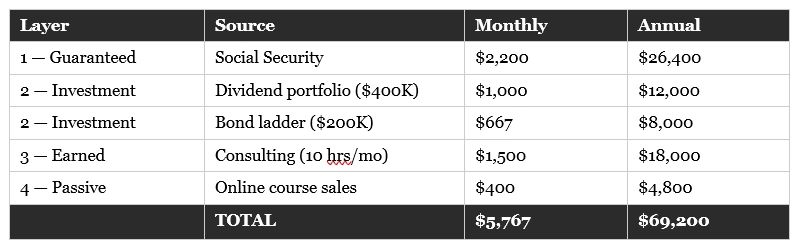
That is $69,200 per year without touching principal. Above the average retiree spending level. And look at what happens if one layer takes a hit. If the consulting dries up, she still has $51,200. If the market pulls back and dividends drop, she still has Social Security, bonds, and earned income. No single point of failure. That is the power of layers.
Frequently Asked Questions
What is the best passive income stream for retirees?
Dividend investing is the most accessible and reliable for most people. A well-diversified dividend portfolio of $300,000 to $500,000 can generate $9,000 to $15,000 per year with minimal maintenance. If you have expertise to share, digital products and online courses are excellent because they scale without requiring more of your time.
Will working in retirement reduce my Social Security benefits?
Only if you claim before full retirement age and earn above $24,480 in 2026. After full retirement age, there is no earnings limit. And any benefits withheld before full retirement age are recalculated to increase your future monthly benefit. They are deferred, not lost.
Is it too late to start building retirement income streams at 60?
Not even close. A dividend portfolio starts paying immediately once funded. Consulting income can begin within weeks if you pick up the phone and call someone in your network. An online course can be built in 2 to 4 months. Even one additional income stream changes your math and your confidence.
How much of my retirement income should be guaranteed?
Enough to cover your non-negotiable expenses — housing, food, healthcare, utilities, and insurance. If Social Security handles those basics, everything else is flexibility. If it does not, an annuity or part-time work can fill the gap until your other layers are established.
Do I need all four layers?
No. Some women have two strong layers and that is plenty. Others build all four. The point is not a checklist. The point is that your income does not depend on one single source that can be disrupted. Even adding one layer to what you already have makes you significantly more resilient.
Your Career Ends — Your Income Does Not Have To
The paycheck stops. That part is inevitable. But the income? That is entirely up to you.
The women who retire with confidence are not the ones who crossed their fingers and hoped for the best. They are the ones who built layers. Layer by layer, stream by stream, they created a financial life that does not depend on any single source, any single employer, any single policy decision in Washington, or any single day on Wall Street.
You can do the same thing. It does not matter if you are 45 or 65. It does not matter if you are starting from scratch or adding to what you have already built. What matters is that you start. Today. Not next quarter. Not when things settle down. Today.
One stream. Then another. Then another. Each layer you build makes you more resilient, more independent, and more free. And that is a retirement worth having.
Your Next Step
Take the free PROS+ assessment at redefineyourretirement.orgto identify the gaps in your retirement plan, including income diversification. Then explore the Retire Her Way blog for straight talk about building a retirement that works for your life.