
Retirement Planning for Single Women: Going Solo

Building security and freedom when the math doesn't add up
Here's the real paradox: single women need more money for retirement but have less ability to save it. You're paying full rent on one income. Healthcare costs hit you alone. Society expects you to maintain appearance standards that cost real money. You might be helping aging parents or struggling with adult children. And somewhere in this mathematical impossibility, you're supposed to save for a retirement that could last 30 years.
The financial industry's answer? Save more. Work longer. Retire at 70. As if you haven't thought of that. As if the problem is motivation, not math.
But here's what they won't tell you: single women are quietly revolutionizing retirement by breaking every traditional rule. Not through impossible savings rates or miraculous investment returns, but through creativity, community, and strategies that acknowledge real life. This isn't about retiring at 40 to sail the Mediterranean. This is about securing your future while living your present, even when the numbers say it's impossible.
The Real Math of Single Women's Finances
Let's start with honesty about what things actually cost. The average single woman spends significantly more than single men on necessities, not by choice but by societal reality.
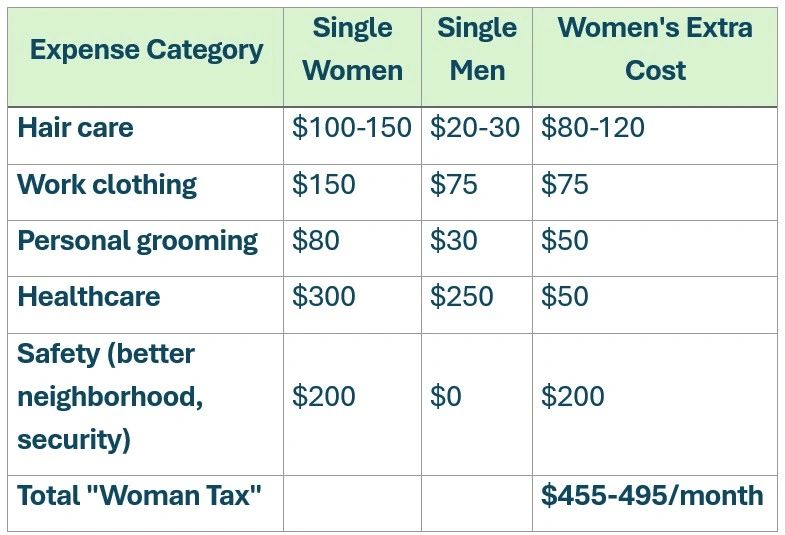
That's nearly $6,000 annually in extra costs just for being a woman in professional America. Hair care that's professional-appropriate costs $100+ monthly while men spend $20 on haircuts. Work clothes that meet "professional" standards cost more in the women's department. Healthcare costs more – gynecological care, mammograms, higher medication prices for similar conditions. Women pay more for safer housing in better-lit areas with security features.
The Bureau of Labor Statistics shows single women earning $45,000 annually typically have this monthly breakdown:
Housing: $1,400 (31% of gross income) Transportation: $650 (car payment, insurance, gas, maintenance) Food: $350 Healthcare: $300 (insurance premiums, co-pays, medications) Personal care: $150 (the "woman tax" on grooming) Utilities: $200 Phone/Internet: $100 Clothing: $100 Everything else: $500
That's $3,750 monthly on a $3,750 gross income (before taxes). After taxes, you're underwater before saving a penny.
The traditional advice – save 20% for retirement – is mathematically impossible. You can't save $750 from income that's already negative. This isn't about lattes or avocado toast. This is about structural impossibility.
The Strategies That Actually Work
Since traditional math doesn't work, successful single women use different equations entirely. These aren't get-rich-quick schemes but systematic approaches to an impossible problem.
The Stair-Step Strategy
Instead of trying to save 20% immediately, you build in steps. Year one: save 1% of gross income. That's $37.50 monthly on a $45,000 salary. Absolutely doable by choosing generic groceries or skipping one restaurant meal.
Year two: 2%. Year three: 3%. Small enough that you adjust naturally. By year ten, you're saving 10% without feeling dramatic lifestyle changes. It's not the 20% the experts recommend, but it's infinitely more than the zero you'd save trying to do too much too fast.
A woman starting this at 40, earning $45,000, saving progressively from 1% to 10%, invested in simple index funds, accumulates about $85,000 by age 60. Not retirement-level wealth, but real money that didn't exist before.
The Side Hustle Reality
The gig economy isn't about driving Uber until 2 AM. It's about strategic income additions that don't destroy your life. Consider realistic side income opportunities based on your current skills. If you're administrative, virtual assistant work for 5 hours weekly at $20/hour adds $400 monthly, which means $4,800 annually straight to retirement. Healthcare workers might pick up per diem shifts once monthly for $500, adding $6,000 annually. Those in education can offer online tutoring for 3 hours weekly at $25/hour, generating $300 monthly or $3,600 annually. Retail workers can leverage their expertise into personal shopping or closet organization for two clients monthly at $200 each, adding $4,800 annually.
These aren't career replacements. They're strategic supplements that make saving possible when your main income doesn't stretch.
The Geography Strategy (States That Actually Want You)
Several states actively recruit new residents with concrete incentives, particularly for remote workers and professionals. These aren't vague promises but real programs with real money.
Vermont offers up to $10,000 over two years through the Remote Worker Grant Program for people who relocate and work remotely. That's $5,000 per year toward your retirement savings just for moving. Tulsa, Oklahoma provides $10,000 cash plus free co-working space for a year through Tulsa Remote, and housing costs are 60% lower than coastal cities – a nice two-bedroom apartment costs $900 versus $2,500 in Denver. West Virginia offers $12,000 cash plus $8,000 in outdoor recreation incentives through Ascend WV, and the state has no tax on Social Security benefits, making it ideal for phased retirement. Maine provides student loan forgiveness up to $25,000 through the Opportunity Maine Tax Credit for STEM graduates who relocate, and lower housing costs plus loan forgiveness can free up $1,500+ monthly for retirement savings. Kansas offers up to $15,000 for remote workers moving to participating communities, with Topeka specifically adding up to $10,000 for home purchases.
Tech hubs outside Silicon Valley are actively hiring with lower costs of living. Austin, Texas offers no state income tax, saving 5-9% of gross income immediately, with tech companies hiring aggressively at salaries only 10-15% below Bay Area rates but housing costs 50% lower. Raleigh-Durham, North Carolina's Research Triangle has massive tech growth with housing costs 60% below San Francisco, and companies like IBM, Cisco, and MetLife have major operations there. Columbus, Ohio is building Intel's $20 billion chip facility creating thousands of jobs, with housing costs 70% lower than coastal cities – a $250,000 house in Columbus would cost $850,000 in Seattle.
Even moving within your current state can save thousands. In Illinois, moving from Chicago to Peoria saves $15,000+ annually in housing costs. In California, Sacramento costs 50% less than San Francisco with just a 90-minute distance.

Building Wealth on Real Incomes
The investment advice single women receive is often absurdly conservative. "You need stability," advisors say, putting you in bonds earning 3% when inflation is 3.5%. You're literally losing money "safely."
Here's investment reality for women earning $35,000-60,000:
Starting with Nothing at 40
Open a Roth IRA. Start with $50 monthly – less than most cable bills. Invest in a single target-date fund appropriate for your age. No complex strategies, no stock picking, just consistent contributions.
Increase by $10 monthly each year. Year one: $50. Year two: $60. Year three: $70. By year five, you're contributing $100 monthly without lifestyle pain. By year 15, you're at $200 monthly.
A woman starting at 40 with nothing, building from $50 to $200 monthly over 20 years, invested in index funds returning 6-7% annually, accumulates approximately $65,000 by age 60. Add Social Security and its workable retirement income.
Starting with Nothing at 50
The math is tighter but not impossible. You need to save more aggressively – starting at $100 monthly minimum, building to $300 as quickly as possible. Work until 67 instead of 62. Those extra five years of contributions plus growth could mean the difference between poverty and security.
Consider working part-time from 67-70. Even $1,000 monthly delays drawing from savings, letting them grow. Three years of part-time work can add 30% to your nest egg.
The 401(k) Reality
If your employer offers a 401(k) with matching, contribute exactly enough to get the full match – that's free money. A 50% match on 6% of your salary means on $45,000 income, your employer adds $1,350 annually when you contribute $2,700.
Can't afford 6%? Start with 1% and increase by 1% annually. You'll barely notice the paycheck difference, but the compound effect is substantial.
Protecting Assets You Don't Have Yet
Single women are targets for financial predation, even when they have modest assets. Protection isn't paranoia; it's practical.
The Romance Scam Protection Plan
You don't need millions to be targeted. Scammers target women with steady jobs and small savings. The FTC reports median losses of $2,400 per victim, but many lose their entire retirement savings.
To spot fake profiles and bots, run a reverse image search on profile photos using Google Images. Right-click the photo, select "Search image with Google." If the photo appears on multiple sites with different names, it's stolen. Look for red flags like photos that look like model shots with perfect professional lighting, grammar mistakes that seem odd for their claimed education level, falling in love within days or weeks, never being able to video chat due to broken cameras or being overseas, stories about being widowed with one child, and claims of working on oil rigs, in the military, or international business.
Use BeenVerified at $26.89 monthly to check anyone you're dating. Enter their name and location to find criminal records and bankruptcies, multiple aliases or name variations, marriage and divorce records, property ownership, and social media profiles that don't match their stories.
Never give financial details in the first year of any relationship. "I'm financially stable" is sufficient information. If pressed for specifics, that's your red flag. Keep one account that no one knows about. Even $1,000 in a separate bank provides emergency options. Open it at a different bank than your main accounts. No romantic partner, family member, or friend should know it exists. Before lending money or combining finances, see their credit report. Anyone legitimate won't object. You can both pull reports together at annualcreditreport.com (free) or pay $30 for instant access. It's not unromantic; it's intelligent. Someone with nothing to hide will appreciate your prudence.
The Family Financial Boundary
Single women often become the default family bank, with everyone from adult children to distant cousins assuming you have disposable income because you don't have "real" family expenses. Setting boundaries isn't selfish; it's survival, and it starts with your own household. When adult children return home – and 52% of young adults lived with parents in 2020 – you need more than good intentions to protect your retirement. Create a formal written agreement that specifies their contribution of 25% of their income or $500 monthly, whichever is less. This money covers their share of utilities and food, and it goes directly into your retirement account, not your general spending. The agreement should include a clear timeline: six months if they're job searching, one year if they're saving for a deposit, and two years maximum unless they're dealing with disability or serious illness. Having parties sign this document prevents "temporary" from sliding into permanent dependency.
Beyond financial contributions, adult children living at home need to function as adult roommates who happen to be related. They should handle specific household responsibilities like grocery shopping, lawn maintenance, or serving as your tech support. This arrangement maintains adult dynamics rather than reverting to parent-child patterns that can trap both of you in roles that no longer serve anyone's interests. The boundary extends to financial entanglements beyond housing. Never co-sign loans – not for student debt, car purchases, or apartment leases. If your adult children can't qualify for credit on their own, they can't actually afford what they're trying to buy, and your retirement security cannot be their backup plan. This might feel harsh, but poverty in your 70s because you co-signed a loan in your 50s is harsher.
For extended family members who inevitably come to ask for help, create a specific "helping others" budget category. Whether that's $50 or $200 monthly depends on your situation, but when it's gone, it's gone. Saying "I've allocated my helping budget for this month" feels less personal than a flat "no" and protects you from guilt-driven financial decisions. Any money you give to family should be considered a gift, never a loan. Family loans destroy both relationships and retirement plans with equal efficiency.

Community Solutions to Solo Challenges
The biggest single woman's advantage isn't mentioned in any financial planning book: other single women. Community solutions to impossible problems are emerging everywhere, and housing partnerships are leading to this revolution. Single women are buying houses together – not romantic partnerships, but strategic financial ones that transform retirement economics. When two women purchase a duplex together, they each pay around $800 monthly instead of $1,500 in rent, building equity while cutting costs and maintaining their independence. The legal structure for these arrangements matters enormously. By forming an LLC that owns the property and creating operating agreements that cover every possible scenario from one owner wanting to sell to disagreements about repairs, women invest about $1,500 in legal fees to save $8,400 annually each in housing costs.
Some women are taking this concept even further with "golden girls" arrangements where four women share a large house, each maintaining private space while sharing communal areas like kitchens and living rooms. In markets where studio apartments cost $1,500 monthly, these arrangements drop individual costs to $500-600 while providing built-in social support and security. The financial math is compelling, but the social benefits – having someone notice if you don't emerge for morning coffee, sharing meals when you feel like company, splitting the cost of home maintenance – might be even more valuable than the monetary savings. These aren't communes or compromises; they're strategic alliances that acknowledge the reality that aging alone is both expensive and risky, while aging in community provides both financial and personal security.
Care Partnerships
Single women are creating formal care agreements that provide security without cost. These aren't vague promises but written contracts with specific commitments. In Minneapolis, four women created "The Care Square," where each commits to 20 hours monthly of care for others when needed. When Martha had knee surgery, the others provided meals, transportation, and overnight stays. When Susan's mother was dying, they covered her pet care and house maintenance. The written agreement specifies what's covered (surgery recovery, family emergencies) and what's not (ongoing eldercare, financial support).
In Phoenix, six retired teachers formed a "Medical Buddy System" where each person is assigned a primary and backup buddy. They attend important doctor appointments together, taking notes and asking questions. During Carol's cancer treatment, her buddy attended all oncology appointments, managed medications, and coordinated with insurance. The buddy's backup covered when the primary was traveling. In Portland, eight single women created a "Care Fund Co-op" where everyone contributes $50 monthly to a dedicated account. When someone needs help – medical equipment, home health aide, temporary assistance – the fund provides up to $2,000 per incident, $5,000 annually per person. In three years, they've covered everything from post-surgery home care to emergency dental work.
The key to successful partnerships lies in written agreements, specific commitments, regular meetings, and clear boundaries. These aren't friendships that might help; they're contractual relationships that will help.
Skill Sharing Networks
Beyond housing partnerships, single women are creating skill-sharing networks that generate thousands in value without any money changing hands. The concept is simple but powerful: you do my taxes while I handle your marketing, or you fix my computer while I alter your clothes for that important interview. These bartering arrangements acknowledge that everyone has valuable expertise, and pooling these skills creates wealth without spending. Online communities specifically for single women over 40 are exploding across platforms, from Facebook groups to Meetup networks to local organizations, but these aren't dating sites or social clubs. They're strategic financial and practical support networks where women share everything from investment advice to recommendations for trustworthy contractors to alerts about job openings that never make it to public postings.
Building Your Next Chapter (Not Just Working Longer)
Traditional retirement assumes you work until you drop, then stop. But single women are rewriting this narrative entirely. You're not extending your sentence; you're designing your second act. The key is starting that transition while still employed, not stepping out on faith without a parachute.
Faith without works is dead, and starting a business without income is dangerous. Build your next chapter while your current job pays the bills. Start your business as a side project, testing the market with 5-10 hours weekly. If you're an HR manager, start consulting on weekends. If you're a teacher, develop online courses in the evenings. If you're in healthcare, begin patient advocacy work on your days off.
Use your current job to fund your future business. That annual bonus becomes your business startup fund. That tax refund pays for your website and marketing. Build the plane while you're flying it but keep flying the one that's paying you. The goal isn't to match your current salary immediately. It's to create $1,000-2,000 monthly in reliable income before leaving traditional employment. This provides a bridge to Social Security and reduces retirement savings withdrawal.
Smart women are negotiating phase-down arrangements that transform the traditional cliff of retirement into a gentle slope. Rather than working full-time until Friday and retiring completely on Monday, you negotiate to work four days, then three, then eventually two, keeping income flowing while gradually building your retirement life. Many employers actually prefer this arrangement because keeping an experienced worker part-time cost less than recruiting, hiring, and training replacements who might leave within two years anyway.
After accumulating 20 or more years in any field, you possess institutional knowledge that has real monetary value, though perhaps not at the $200 hourly consulting rates that fill unrealistic retirement dreams. The real opportunities lie in training your replacement at your current company for $30-50 an hour as a contractor, or writing the procedures manuals that only you can create because you're the only one who actually knows how things work. Smaller companies desperately need expertise but can't afford full-time specialists, so offering them 10 hours monthly at $50 an hour provides them incredible value while generating $500 in reliable income for you. Community colleges constantly seek instructors with real-world experience, often requiring only a bachelor's degree, and teaching two courses per semester can generate $10,000-15,000 annually while keeping your mind sharp and your professional identity intact.
For women bridging the gap to Medicare, working part-time specifically for benefits rather than salary becomes a strategic choice. Twenty hours weekly at companies like Starbucks, Costco, or Trader Joe's provides health insurance worth $10,000 or more annually, and while the paycheck provides nice supplemental income, the benefits are the real goal, essentially earning you $500 weekly in insurance value for half-time work.
Social Security Strategies for Single Women
When Social Security represents your primary or only retirement income source, optimizing these benefits can mean the difference between security and poverty, yet most women claim as early as possible without understanding the long-term cost. Every year you delay claiming from your full retirement age of 67 until age 70 increases your benefit by 8%, which means if your benefit at 67 would be $1,500 monthly, waiting until 70 provides $1,860 – an extra $4,320 annually for the rest of your life. However, this math only works if you can actually afford to wait, and for many women, taking benefits at 67 or even 62 while continuing part-time work creates more financial security than trying to live on nothing while waiting for maximum benefits that might never be enjoyed if health fails.
Women who were married for at least 10 years have an option many never realize exists: claiming on an ex-spouse's record if that benefit exceeds their own. You can receive 50% of your ex-spouse's full retirement age benefit without them ever knowing you're claiming, and it doesn't affect their benefits or their current spouse's benefits at all. For widows, the strategies become even more complex but potentially lucrative, as you can claim survivor benefits as early as 60 (or 50 if disabled), then let your own benefit grow until 70 before switching, effectively providing income for a full decade while still maximizing your personal benefit for the longest possible retirement.
The Ten-Year Reality Plan

Rather than chasing early retirement fantasies that require impossible savings rates, successful single women follow a realistic progression that acknowledges both the constraints and opportunities of each life stage.
Ages 40-50: Foundation Building
During your 40s, foundation building means starting where you are rather than lamenting where you should be. Begin by saving just 1-5% of income, increasing gradually each year as raises come through or debts get paid off, because 1% saved consistently beats 20% attempted and abandoned. Add $200-500 monthly through strategic side income that enhances rather than exhausts you – perhaps virtual assistant work you can do while watching Netflix or weekend tutoring that keeps your skills sharp. Before aggressive retirement saving, build that emergency fund to $5,000 minimum because one medical crisis or car repair shouldn't derail your entire retirement plan. Learn basic investing through target-date funds that automatically adjust as you age, requiring no expertise or constant monitoring, just consistent contributions that you increase slightly each year.
Ages 50-55: Acceleration
Your early 50s become the acceleration phase where compound interest finally starts showing its power. Increase savings to 10% by directing every raise to retirement rather than lifestyle inflation and take full advantage of those catch-up contributions that add an extra $7,500 to 401(k)s and $1,000 to IRAs annually. Pay off all high-interest debt during these peak earning years, freeing up hundreds monthly that can redirect to savings, and consider geographic arbitrage within your region – perhaps moving 30 miles outside the city to cut housing costs by 40% while maintaining your income level.
Ages 55-60: Maximization
The late 50s represent your maximization window where everything comes together. Push savings to 15% if possible through your highest career earnings rather than extreme frugality that makes life miserable and maximize every available catch-up contribution including HSAs that triple as emergency funds, retirement accounts, and healthcare coverage. Build your healthcare bridge strategy now while you have time to adjust, researching whether part-time work benefits or ACA subsidies make more sense for your situation. Create that phase-down work plan with your employer, proposing gradual reduction rather than abrupt retirement that shocks both your finances and your identity.
Ages 60-67: Transition
Your 60s become the transition years where flexibility matters more than rigid plans. Work part-time if health allows, earning enough to cover expenses while letting retirement accounts grow untouched for a few more crucial years. Delay Social Security if you can manage without it, remembering that each year from 67 to 70 increases benefits by 8%, but don't sacrifice your health or happiness for slightly higher benefits you might not live to enjoy. Test living on projected retirement income for six months before actually retiring, identifying gaps while you still have time and ability to address them. Build those community support systems through care partnerships and skill-sharing networks that provide security without cost, because isolation kills retirement dreams faster than poverty.
Ages 67+: Sustainable Retirement
After 67, sustainable retirement means claiming Social Security strategically based on your actual health and family longevity patterns rather than generic advice, while maintaining part-time work that provides purpose and social connection beyond just income. Use every available community resource from senior centers to nonprofit assistance programs to government benefits you've earned through decades of work and paying into the system. Focus intensely on preventive health measures, because medical bankruptcy remains the leading cause of senior poverty, and a $50 gym membership beats a $50,000 hospital stay every time.
The Truth About Single Women's Retirement
The single woman's paradox isn't that retirement is impossible. Its that traditional strategies assume resources you don't have while ignoring advantages you do. You can't save 20% of income that barely covers expenses. You can't invest aggressively when one medical emergency could destroy you. You can't retire at 50 when you started saving at 45.
But you can build security through community. You can create income streams that don't require capital. You can leverage every available resource, from ex-spouse benefits to pharmaceutical assistance programs. You can work strategically instead of desperately.
Most importantly, you can reject the narrative that single women face inevitable poverty. Yes, the math is harder. Yes, the challenges are real. But thousands of single women are creating secure retirements through creativity, community, and sheer determination.
Your retirement won't look like the financial industry's ideal. It might involve roommates at 70. Part-time work at 68. Geographic moves for economics, not adventure. But it can still be secure, dignified, and even enjoyable.
The key is starting now with what's actually possible, not waiting for what's ideal. Save 1% if that's what you can do. Earn an extra $100 monthly if that's available. Build one relationship that might provide mutual support. Take one small step toward security.
Single women don't need miracles to retire. They need strategies that acknowledge reality while building toward security. The paradox isn't that it's impossible. The paradox is that it requires breaking every traditional rule to achieve a non-traditional but very real retirement.
Your security is possible. Not through impossible savings rates or investment miracles, but through strategies designed for your actual life. Start where you are, with what you have, knowing that small steps consistently taken lead to destinations that seem impossible from the starting point.