
The Retirement Housing Decision: Stay, Downsize, or Move

I almost moved last year. Sat down, ran every number, toured apartments, compared neighborhoods. I was ready. Then my leasing office raised my rent by $15. Fifteen dollars. And just like that, the math flipped. The cost of moving, the smaller space I would have gotten, the hassle of starting over — none of it made sense anymore for a $15 increase. I stayed.
That experience taught me something I want every woman approaching retirement to hear: your retirement housing decision is one of the most powerful financial moves you will make, and it deserves more than a gut reaction. It deserves math. It deserves honesty. And it deserves time.
I will tell you something else. I own a condo in Atlanta that I paid for in cash. When I am ready to retire and my current lease is up, I can move there and my only housing cost will be the HOA, about $600 a month. Compare that to the $3,100 I pay now in rent. I could live on my Social Security check alone and not touch my savings. That did not happen by accident. It happened because I thought about housing as a retirement strategy, not just a place to sleep.
The 2026 Clever Real Estate survey found that retirees now believe they need an average of $823,800 to retire comfortably. Yet the average retiree has only $288,700 saved. When you are working with less, where you live becomes one of the most powerful levers you have.
So let us talk about your three options honestly. No top 10 lists. No glossy pictures of beach condos. Just the real math, the real tradeoffs, and the real questions you need to ask yourself.
The Decision Most Women Avoid Until It Is Too Late
Here is what usually happens. A woman retires, stays in the family home because it is comfortable, and ten years later realizes the house is too big, too expensive, too hard to maintain, and too far from the things she actually needs. Doctors. Community. Family. Spaces she can safely navigate as her body changes.
By then, the move is harder. Health may have declined. The real estate market may have shifted. And the emotional weight of leaving a home full of memories gets heavier every year you wait.
According to a U.S. News survey, 95 percent of people 55 and older said aging in place was important to them. But wanting to stay and being able to afford it are two different conversations. A 2024 survey found that 67 percent of seniors said rising costs made aging in place harder. Meanwhile, a Redfin survey found that 1 in 3 boomers say they will never sell their homes, and more than half have paid off their mortgage, which removes the urgency but hides the ongoing costs.
The best time to make this decision is before you need to. Not after a fall. Not after a diagnosis. Not after the money gets tight. While you still have options.
Aging in Place: What It Really Costs to Stay Home
Aging in place sounds wonderful. You stay in your home, your neighborhood, your life. And for many women, it is the right choice. But it is also the most underestimated choice in terms of what it actually costs, and I want you to go in with your eyes open.
The appeal is obvious. This is your home. Your memories. Your garden. Your neighbors who wave when you pull in the driveway. And if you have equity built up, the Intercontinental Exchange Mortgage Monitor reports the average homeowner has $212,000 in tappable equity as of mid-2025. That is real money.
But here is the part nobody mentions in the brochures. Only 10 percent of homes in the U.S. are set up to accommodate older adults. That means 9 out of 10 homes need work before they are truly safe for aging. Grab bars run $150 to $500 each installed. A walk-in shower conversion is $3,000 to $10,000. A stairlift is $2,500 to $8,000. A full accessibility renovation can run $25,000 to $50,000 or more.
And those are one-time costs. The ongoing expenses are what really add up. Property taxes do not stop when your paycheck does. Maintenance runs 1 to 3 percent of your home’s value every year, so a $350,000 home means $3,500 to $10,500 annually just to keep things from falling apart. Homeowner’s insurance has surged in many markets. And if you need in-home help, aides average $30 to $35 per hour. Even 10 hours a week runs $15,000 to $18,000 a year. That is real money coming out of your retirement every single month.
Help That Exists and Most People Miss
Here is some good news. Medically necessary modifications may be tax-deductible if your total medical expenses exceed 7.5 percent of your adjusted gross income. The USDA Section 504 program offers grants up to $10,000 for low-income rural seniors. Some Medicare Advantage plans now cover home modifications as a supplemental benefit. And Medicaid waivers may help in some states. The money is out there. You just have to know where to look.
When Staying Works and When It Does Not
Aging in place works when your home is manageable, your costs are sustainable on retirement income, you have people nearby who care about you, and you love the area. It gets risky when the house needs more than you can afford to fix, you are isolated, the neighborhood is not walkable, or you are far from good healthcare. Be honest with yourself. I know it is hard. But this is not about sentiment. It is about your safety and your money.
Downsizing in Retirement: The Math Nobody Shows You

If you are asking yourself should I downsize in retirement, you are already asking the right question. Selling your current home and moving to something smaller is the most commonly recommended strategy, and the logic sounds simple: sell high, buy low, pocket the difference. But the math is more complicated than the headlines suggest, and I want you to see the real numbers.
On the gains side, you might release $100,000 to $500,000 in equity. You reduce property taxes, utilities, maintenance, and insurance by thousands per year. That freed-up money goes into your retirement accounts or your monthly cash flow. It can be life-changing.
But here is what most articles skip. Real estate commissions run 5 to 6 percent of your sale price. On a $450,000 home, that is $24,750 right off the top. Add buyer closing costs, moving expenses, and new furnishings, and a woman who expected to pocket $200,000 might actually net closer to $155,000. Still significant. But 23 percent less than the number she had in her head. You need to know the real number, not the dream number.
Something Widows Need to Know
If your spouse recently passed, you may be able to use the $500,000 married capital gains exclusion if you sell within two years and have not remarried. This is time-sensitive and many widows do not know about it until it is too late. If this applies to you, talk to a tax professional now, not next year.
The 2026 Market
Mortgage rates have stabilized near 6 to 6.3 percent according to Redfin. The National Association of Realtors is forecasting a 14 percent increase in existing home sales. Inventory is improving. And here is the thing — for retirees who own outright and can buy smaller with cash, mortgage rates do not even matter. You are just converting a large asset into a smaller one plus cash reserves. That is a powerful position to be in.
Related reading: How to Build Wealth for Retirement: A Woman’s Guide | Retirement on a $50K Income: How to Make It Work
Retirement Relocation: Beyond Sun and Low Taxes
Retirement relocation is the most dramatic option and the one with the widest range of outcomes. Done right, it can transform your retirement. Done impulsively, it becomes an expensive mistake you spend years unwinding. So let us talk about what “done right” looks like.
The Financial Case
When evaluating the best states to retire, the differences are real and they are not small. A retiree with $60,000 in annual income can see a $5,000 to $10,000 difference in after-tax income just by choosing a different state. Nine states have no state income tax: Alaska, Florida, Nevada, New Hampshire, South Dakota, Tennessee, Texas, Washington, and Wyoming. But no income tax does not always mean lowest total cost. Texas has high property taxes. Washington has high sales tax. You have to look at the whole picture.
Only 8 States Still Tax Social Security
As of 2026, according to Kiplinger, only eight states still tax Social Security: Colorado, Connecticut, Minnesota, Montana, New Mexico, Rhode Island, Utah, and Vermont. West Virginia, Kansas, Missouri, and Nebraska all eliminated theirs in recent years. If you are living in one of those eight states and Social Security is a big piece of your income, that alone might be worth a conversation about relocating.
What the Spreadsheet Cannot Tell You
This is the part I really want you to hear, because the retirees who relocate successfully think about more than taxes. They think about healthcare access and whether there are good Medicare Advantage plan options in that zip code. They think about social infrastructure, because the number one regret of retirement relocators is underestimating how hard it is to make friends at 65 in a place where you know nobody. They think about transportation, because a beautiful rural lot becomes a prison when you can no longer drive. And they are honest about proximity to family. A cheap house three states away from your grandchildren might save you money, but it costs you something money cannot replace.
The Trial Run
Before you commit, rent in your target location for 3 to 6 months. I cannot stress this enough. Experience the worst weather season. Try the healthcare system. Join a class or a church. See if the community fits before you sell your house and move your life. This is the single best investment you can make in a relocation decision, because selling your home, moving across the country, and discovering you are miserable is an extremely expensive mistake to undo.
Related reading: Your Second Act Abroad: How to Navigate International Retirement | 5 Ways to Prepare Emotionally Before You Retire
The State Tax Picture: Where You Live Changes Everything
Your retirement housing decision and your tax decision are deeply connected. And I know taxes are not anyone’s favorite topic, but this is where the real money lives. Here is what the difference looks like in real numbers when you compare a high-tax state to a low-tax state for a retiree.
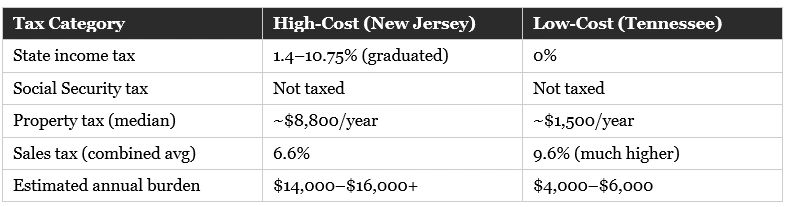
That is potentially $10,000 or more per year in savings. Over a 20-year retirement, that is $200,000. But notice that Tennessee’s sales tax is actually much higher than New Jersey’s, and New Jersey does not tax Social Security at all. The point is not that one state is always better. The point is that you have to run the complete numbers for your situation — income tax, property tax, sales tax, and cost of living — before you make a move.
Related reading: The Retirement Tax Playbook for Women
How Your Housing Choice Touches Everything Else
You might not think about it this way, but where you live in retirement touches almost every other financial decision you make. Let me walk you through it.
Your Medicare options change by zip code. Premiums for Original Medicare are the same everywhere, but Medicare Advantage plans are a completely different story. Some metro areas have 30 or more plans competing for your business with great benefits. Move to a rural area and you might have 2 choices. That is a big deal when you are choosing the healthcare coverage you will live with every day.
Your Social Security stretches differently depending on where you spend it. Federal benefits are the same no matter where you live, but 8 states add their own tax on top. And cost-of-living adjustments are calculated nationally, so if you are living somewhere with a lower cost of living, that annual COLA goes further. Same check, more purchasing power.
Your estate plan may need to change. Some states have estate tax exemptions as low as $1 million. If your home equity plus your retirement savings puts you above that threshold, your heirs could face a state estate tax bill even though you are well under the $13.99 million federal exemption. Where you live affects what you leave behind.
Long-term care costs and coverage vary dramatically. Medicaid eligibility rules are different in every state, and Medicaid is the largest payer of long-term care in America. If there is any chance you will need care down the road, and statistically there is, the state you live in matters more than most people realize.
Give Yourself Time to Decide
If you are not sure what to do, that is perfectly fine. There is no rule that says you have to decide all at once, and honestly, rushing this decision is how people end up regretting it. Here is what I suggest instead.
Give yourself a window. Maybe a year, maybe two or three. Use that first stretch for research. Run the numbers for all three options. Visit potential destinations. Talk to a fee-only financial advisor who can model the tax impact of different states. Use the next stretch for testing. If you are thinking about relocating, do a trial rental. If you are leaning toward aging in place, get quotes on the modifications you will need and see if the numbers work. If you are considering downsizing, start exploring the market so you know what is realistic. Then decide. By that point you have data, experience, and clarity — not just a feeling. Make the move or commit to staying, but do it with your eyes open and your numbers solid.
Related reading: Staying Active in Retirement: Why Movement Matters | Financial Independence for Women Over 50
Frequently Asked Questions
Is it better to rent or buy in retirement?
It depends on your situation and how long you plan to stay. Renting eliminates maintenance, property tax increases, and modification costs. Buying builds equity and provides stability. My advice? If you are moving somewhere new, rent first. Test the location before you commit your money to it.
What is the biggest housing mistake retirees make?
Waiting too long to decide. The best retirement housing decisions are made when you have time to research and choose, not when a health crisis forces your hand. Start thinking about this 3 to 5 years before retirement. You do not have to act right away. But you should be planning.
Should I pay off my mortgage before retiring?
Generally yes, if you can do it without draining your retirement accounts. A paid-off home cuts your monthly expenses dramatically. But do not empty your 401(k) to pay off a low-interest mortgage — the math often does not work after taxes and penalties. Talk to your advisor before making that call.
How do I handle the emotional side of leaving my home?
Give yourself permission to grieve. Your home holds decades of memories and that is real. Take photos. Keep the things that matter most. And then try to focus on what the new space will make possible, not just what you are leaving behind. I have talked to so many women who said the anticipation was harder than the actual move. Once they settled in, they wondered why they waited so long.
Your Home Should Work for Your Life
Your home is not a museum for your past. It is the foundation for your future. The right choice, whether that is staying put, downsizing, or moving across the country, is the one that supports the life you actually want to live right now. Not the life you lived 20 years ago.
Run the numbers. Visit the places. Ask the hard questions. Talk to the people you trust. And make the decision on your timeline, not when a crisis forces your hand.
Your retirement deserves a home that fits. And so do you.
Your Next Step
Take the free PROS+ assessment at redefineyourretirement.orgto identify gaps in your retirement plan, including housing and financial readiness. Then explore the Retire Her Way blog for more straight talk about building a retirement that works for your life.