
SEP-IRA vs 401(k): What Self-Employed Women Should Know
If you have a side business, freelance income, or you run your own show — there's a retirement account that's been waiting for you. And yes, you can have it on top of your 401(k).
Let's be real for a second. The retirement planning world has done a terrible job of telling women about all their options. They hand you a 401(k) brochure, maybe mention an IRA if you're lucky, and send you on your way. As if that's the whole story.
It's not.
If you have any kind of self-employment income — a side business, consulting work, freelance projects, or a company you own — there's a retirement account specifically built for people like you. It's called a SEP-IRA. The IRS officially calls it a 408(k) plan. And it can supercharge your retirement savings in ways a regular IRA simply can't touch.
OK, What Even Is a SEP-IRA?
SEP stands for Simplified Employee Pension. Congress created it in 1978 — back when they actually wanted to make it easier for small businesses to offer retirement benefits. (Imagine that.)
Here's how it works: instead of the employee putting money in, the employer contributes. If you're self-employed, plot twist — you're both the employee AND the employer. So, you're contributing to yourself. Love that for us.
The money goes into an individual IRA-style account. It's yours immediately. No vesting schedule, no waiting period, no "you have to stay three more years" strings attached.
✅ The SEP-IRA was designed to be simple. No annual IRS filings for most plans. Low administrative costs. You can open one at Fidelity, Vanguard, or Schwab — often in an afternoon.
The Part That's Going to Make Your Jaw Drop

In 2026, you can contribute up to $72,000 — or 25% of eligible compensation, whichever is less. That's according to the IRS official 2026 limits released in Notice 2025-67.
Let that sink in. A regular IRA? $7,500. A SEP-IRA? Up to $72,000. That's nearly ten times the limit. If you're running a business that's generating real income and you're not using a SEP-IRA, you are absolutely leaving money on the table. Pre-tax money. Money that could be growing for your future instead of going straight to Uncle Sam.
And yes — pre-tax means tax-deductible. You contribute now, reduce your taxable income today, and pay taxes later when you withdraw in retirement. Same logic as a traditional 401(k) or traditional IRA.
⚠️ Unlike a 401(k), there are NO catch-up contributions for people 50+ with a SEP-IRA. Zero. That's exactly why starting now matters — the window to build is open, but there's no safety net at the back end.
But Wait — I Already Have a 401(k) or 457(b). Can I Have Both?
This is the question I get asked most, and the answer is almost always yes — with one key condition. The 401(k) or 457(b) and the SEP-IRA need to be tied to different income sources. Your employer plan is from your day job. Your SEP-IRA is from your own business income. Two separate sources. Totally allowed.
The key rule: your combined employer contributions generally can't exceed $72,000 in 2026. So, you're not getting two fully separate buckets — but you are getting more flexibility and potentially more total savings than if you were relying on just one plan. Fidelity confirms this: you can contribute to both as long as the plans are with separate employers.
Example: you put $24,500 into your 401(k) at your day job. Depending on your business income, you may still have significant room to contribute to your SEP-IRA on top of that. Both pre-tax. Both building your future.
💡 Own two completely separate businesses? You may be able to get independent contribution limits for each plan. That's a conversation worth having with your CPA — the upside can be significant.
Super Catch-Up for Ages 60–63? Yes, That's a Real Thing.
Here's something the financial industry definitely didn't announce loudly enough. Thanks to the SECURE 2.0 Act, if you're between ages 60 and 63, you qualify for a "super catch-up" on your 401(k) or governmental 457(b).
In 2026, instead of the standard $8,000 catch-up, workers ages 60–63 can contribute $11,250 extra on top of the $24,500 base — for a total of $35,750 in your employer plan. Charles Schwab's catch-up contribution guide has the full breakdown.
The SEP-IRA doesn't offer this super catch-up, but your employer plan does. If you're in this age window, that's an additional opportunity to close any savings gap before retirement. Stack the SEP-IRA on top and you're playing a very different game than most people.
⚠️ High earner alert: Starting in 2026, if your prior-year wages exceeded $150,000, your catch-up contributions to a 401(k) must be made as Roth (after-tax) contributions. Check with your plan administrator to make sure your plan offers a Roth option — otherwise you may not be able to make catch-up contributions at all.
Can I Roll My Old 401(k) or 457(b) Into a SEP-IRA?
Great question — and the answer is yes, with some important nuance depending on which plan you're rolling from.
Rolling Over an Old 401(k)
If you have a 401(k) from a previous employer just sitting there, you can roll it directly into your SEP-IRA. As long as you do a direct trustee-to-trustee transfer — meaning the money goes account-to-account and never passes through your hands — you won't owe taxes and there's no penalty. Your money keeps its tax-deferred status and simply lands in a new home.
✅ The rollover amount does not count against your annual contribution limit. Rolling over old money is consolidation — completely separate from your new annual contributions. See the IRS rollover rules for full details.
Rolling Over a Governmental 457(b) — Read This Carefully
Yes, a governmental 457(b) can be rolled into a SEP-IRA. But before you move anything, there are two things you absolutely need to know.
First: you generally can't roll over your 457(b) while you're still actively employed by the organization offering the plan. Some plans allow in-service withdrawals once you've reached age 59½, but that's plan-specific — not a guarantee. Mission Square outlines the rollover eligibility rules clearly. Always check your plan documents or call your administrator before assuming you can move the money now.
Second — and this is the big one: your 457(b) has a rare superpower that most retirement accounts don't have. Withdrawals from a governmental 457(b) are NOT subject to the 10% early withdrawal penalty, even before age 59½, as long as you've separated from service. The moment you roll that money into a SEP-IRA, it loses that protection and becomes subject to standard IRA withdrawal rules.
⚠️ Once 457(b) money moves into a SEP-IRA, it loses its penalty-free early withdrawal status permanently. Since a SEP-IRA follows traditional IRA rules, withdrawals before age 59½ would be subject to a 10% penalty. If you're already past 59½, this matters less — but it's critical to understand before you move a single dollar.
💡 Have a 457(b) from a government job and wondering whether a rollover makes sense for you? The rules are specific, the stakes are real, and the answer depends on your age, timeline, and income needs. This is exactly the kind of move that deserves a sit-down with a CPA or financial advisor before you do anything.
Always Do a Direct Rollover. Always.
Whether you're rolling over a 401(k) or 457(b), there are two ways to do it: direct and indirect. Only one of them is smart.
Direct rollover: the money moves institution-to-institution. You never touch it. No taxes withheld. No clock ticking. This is the move. The IRS explains both rollover types here.
Indirect rollover: the check comes to you. Your plan is required to withhold 20% for taxes right off the top. You then have 60 days to deposit the FULL original amount — including that withheld 20% out of your own pocket — into the SEP-IRA, or the difference gets treated as a taxable distribution. Miss the 60-day window entirely and you owe income taxes on the whole amount, plus a possible 10% penalty.
⚠️ Never take the check. Always request a direct rollover. There is no scenario where receiving the distribution yourself and then depositing it is the better option.
Is the SEP-IRA a Qualified Plan? What About ERISA?
This comes up a lot, especially for women who are building businesses and thinking seriously about asset protection. Here's the honest answer.
A SEP-IRA is established by an employer (or self-employed person), which means it has some ERISA characteristics — but it is NOT a fully ERISA-protected plan the way a 401(k) is. In practice, this means it has more limited creditor protection. Your 401(k) is strongly shielded from creditors under federal law. Your SEP-IRA's protection depends largely on your state.
In DC and most states, IRA assets are protected in bankruptcy under federal law — but outside of bankruptcy, coverage varies. Fidelity's SEP-IRA overview confirms: SEP-IRAs are not ERISA plans and don't carry the same level of creditor protection. If that's a concern for your situation, talk to an attorney.
💡 Bottom line: the SEP-IRA is a powerful savings vehicle with real tax advantages. But if you're a business owner building real assets, don't overlook the protection differences between your employer plan and your SEP-IRA. Know what you have and how it's protected.
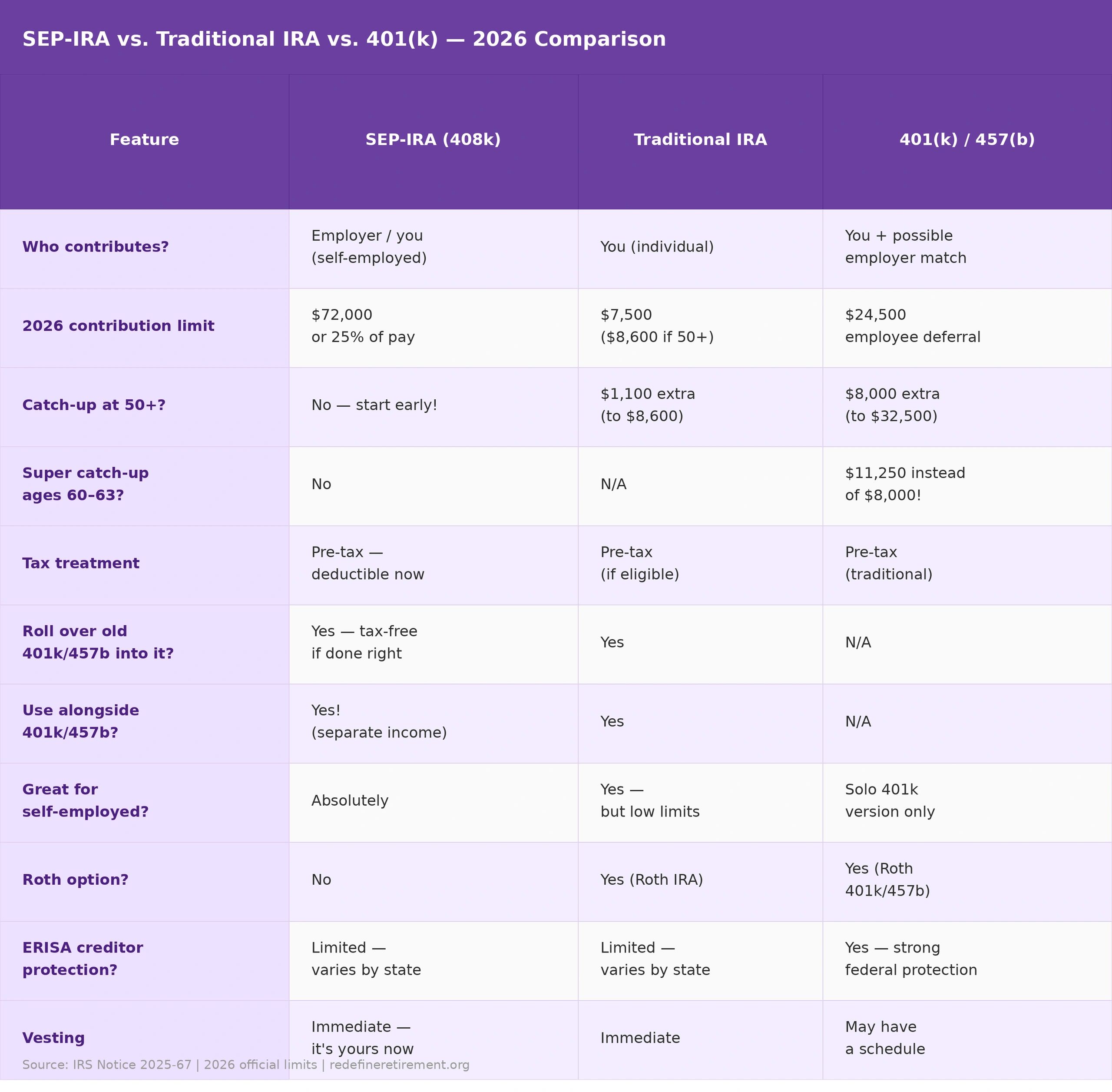
SEP-IRA vs. IRA vs. 401(k): The Full 2026 Picture
Here's everything side by side. Numbers reflect official 2026 IRS limits per Notice 2025-67:
Why This Hits Different for Women
Here's what the financial industry rarely talks about: women's careers don't always follow a straight line. We take time off to raise kids or care for aging parents. We pivot careers. We leave corporate to start something of our own. We get paid less for the same work — and all of that adds up to retirement savings gaps that are very real.
The SEP-IRA was actually built for people with flexible, non-traditional income — which, whether we chose it or not, describes a lot of us. You don't have to contribute every year. If business is slow, skip it. When you have a great year, maximize it. It moves with you.
And for women who started saving for retirement later than they'd like? The higher contribution limits mean you can make up real ground, fast.
How Do You Set One Up?
Easier than you think. You can open a SEP-IRA at Fidelity, Vanguard, Schwab, or most other major financial institutions. The paperwork is minimal compared to a 401(k). There's no annual IRS filing required for most SEP plans.
Here's a bonus you'll love: you can open and fund a SEP-IRA up until your tax return due date, including extensions. So, if you haven't filed your taxes yet, you may still be able to open one and contribute for the prior tax year. Go talk to your tax professional today.
✅ You'll complete a simple IRS Form 5305-SEP (or a prototype version from your financial institution). No annual Form 5500 filing. No third-party plan administrator required. Retirement planning without the red tape.
The Bottom Line

The financial world kept this one quiet for too long. If you have any self-employment income — a side hustle, a business, anything you do independently for pay — you have access to one of the most powerful retirement savings tools out there.
It's pre-tax. It's flexible. The contribution limits are nearly ten times what a regular IRA offers. You can stack it on top of your 401(k) or 457(b). And if you have an old employer plan gathering dust somewhere, you may be able to roll it in — tax-free.
Your 401(k) is cute. But your SEP-IRA? That's the one that's going to change your retirement story.