Quick question. When your employer's open enrollment email lands in your inbox, what do you do with it? If the honest answer is "flag it for later," you are in very good company. You know the folder. It is called Later, and nothing has ever come out of it alive.
Open enrollment is the one stretch of the year when your employer hands you a menu and says, pick. Health plan. Dental. Vision. Life insurance. Disability. Flexible spending. Maybe a health savings account. And it all has to be decided by a deadline, usually while you are also planning Thanksgiving. So most of us do the quick thing. We click "keep my current choices" and close the tab. That is fine for the dental plan. It is not fine for everything on that list, because several of those boxes are retirement decisions wearing a benefits costume.
This week we are going to walk through the ones most of us skip. One thing has to be said out loud first: employers are not alike, so not everything here will be on your menu.
Every Employer Does This Differently
A large company may offer a 401(k) with a match, two or three health plans, an HSA with money put in for you, group life insurance, and short- and long-term disability. A small business may offer a health plan and a handshake. A nonprofit or a school may offer a 403(b). A city or county may offer a 457(b) and a pension. A union shop may have its own rules entirely. And some of us work two part-time jobs, and neither one hands us a menu at all.
Even the price of the same benefit swings wildly. KFF's 2026 Employer Health Benefits Survey, released October 22, found that workers now pay an average of $7,471 a year toward family health coverage, up 9 percent from last year. At small firms, workers pay an average of $9,687 a year for family coverage, which is $2,847 more than workers at large firms pay for the same thing. So everything below carries an invisible asterisk: check your own benefits guide to see whether your plan offers it, and what it costs you.
The 401(k) Match: Check That the Door Is Actually Open
If your employer offers a match, it is part of your pay. There is no standard formula. Yours might be dollar for dollar up to a point. It might be fifty cents on the dollar. It might be tiny, or it might not exist. Open enrollment is a good time to find out, because the benefits guide and the plan website are already open in front of you.
Look for three things. First, the match formula, in plain numbers. Second, how much you have to contribute to get all of it, and whether you are. Third, whether there is a waiting period or a vesting schedule, meaning a number of years before the employer's money is fully yours. Then check your pay stub, not the brochure. Many of us signed up years ago at a low percentage and never looked again, and that number is still quietly running the show.
One timing trap worth knowing about: if you hit the annual contribution limit before the year is over, some plans stop matching for the rest of the year unless they offer what is called a true-up. That mostly matters for higher earners, but it costs nothing to ask.
HSA and FSA: Two Accounts, Two Very Different Rules
These two get confused constantly, so here they are in plain English.
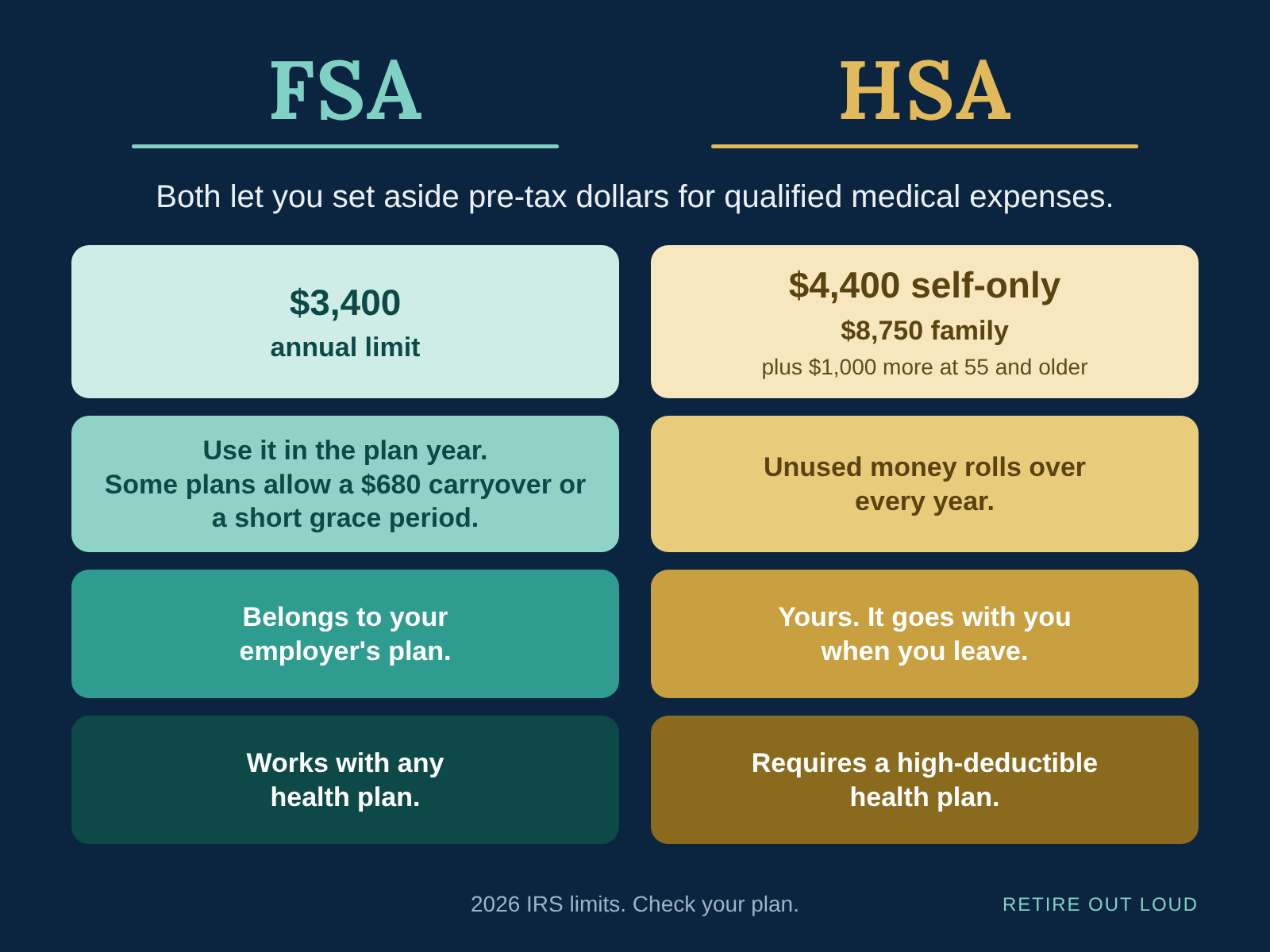
A health savings account, or HSA, is available only if you are enrolled in a qualifying high-deductible health plan. The account is yours. If you change jobs, it goes with you, and what you do not spend stays in the account year after year. For 2026, the IRS limit is $4,400 for self-only coverage and $8,750 for family coverage, and if you are 55 or older you can add $1,000 more. The IRS has already set the 2027 HSA limits: $4,500 for self-only and $9,000 for family. Your employer's contribution counts toward that same limit, so if your job puts money in, you can put in less.
A flexible spending account, or FSA, is different in one big way: it belongs to the employer's plan, not to you. For 2026, the health FSA limit is $3,400, and a plan can let you carry over up to $680 of unspent money into the next year, or give you a grace period of a couple of months to spend it, but a plan can offer one of those or neither, not both. That is the "use it or lose it" rule you have heard about. Your election generally locks in for the whole plan year unless you have a qualifying life event, like a marriage, a divorce, or a baby.
So how do you choose? Do not guess. Look at what you actually spent on medical care this year. If you already know about braces, a surgery, or a regular prescription, an FSA can make sense. If your plan is high-deductible, an HSA is worth a serious look. And remember the lesson from the Medicare article: the cheaper premium is not always the cheaper year.
Dependent Care: Child Care, Elder Care, and the Number That Changed
This one matters to anyone caring for someone at either end of life, and many of us are doing both at once.
If your employer offers a dependent care FSA, it lets you pay for certain care with pre-tax dollars, so the money skips income tax on the way to the daycare, the after-school program, or the adult day care for a parent who cannot be home alone. For 2026 the federal limit rose from $5,000 to $7,500 per household, or $3,750 if you are married and filing separately, because of the 2025 tax law. Here is the catch: your employer does not have to adopt the higher number. Your plan may still cap you at $5,000, or something else. Check.
Unlike a health FSA, a dependent care FSA generally does not offer a carryover, so the amount you elect should be money you know you will spend. The care has to be so you can work, and it has to be for a qualifying person. If that person is your mother, there are tests about whether she counts as your dependent, so talk to a tax professional before you elect a large amount.
Think of this one as a retirement decision too. Every pre-tax dollar you keep is a dollar that could go toward your own future instead of to the IRS. That is not a guilt trip. It is arithmetic.
Life Insurance: The Quiet Gap
Policies come in all sizes, and the size matters. So ask yourself one question: if something happened to you tomorrow, what would the people who depend on you actually have?
Many employers offer basic life insurance at no cost to you, often a flat amount or a multiple of your salary, and many let you buy more. The IRS treats employer-paid group-term coverage up to $50,000 as tax-free; above that, there can be a small tax on the value of the extra coverage. What we want you to see is the gap between what the benefit gives you and what your family would need. If you are a single parent, the main earner in your home, or the person holding up a parent's care, the free amount through work may be a starting point and not a finish line. And group coverage usually ends when you leave the job. This is not a recommendation to buy anything. It is a recommendation to know the number.
Disability Insurance: The One Almost Nobody Looks At
Short-term and long-term disability policies replace part of your paycheck if you cannot work because of illness or injury. Here is why that belongs in a retirement conversation: your biggest retirement asset is not your 401(k). It is your ability to keep earning for the next twenty or thirty years. If illness takes that away for a year, the contributions stop, the match stops, and your Social Security record stops growing.
Read three lines of the disability description. How much of your pay does it replace? How long do benefits last? And who pays the premium? As a general rule, if the employer pays the premium, the benefit is taxable income to you if you ever collect it. If you pay with after-tax dollars, the benefit is generally not taxed. That difference can be the difference between a check that covers the mortgage and one that does not.
Beneficiary Forms: Ten Minutes That Can Outrank Your Will
Your 401(k), your life insurance, and your HSA each have a beneficiary form. That form generally controls who gets the money, no matter what your will says. We wrote about this in You Have an Estate Whether You Know It or Not, and the beneficiary screen is sitting right there in your benefits portal while you have it open.
Do three things. Log in and look at every beneficiary listed, one account at a time. Check that the names are current, because an ex-spouse, a parent who has passed, or no one at all are the most common surprises. And name a backup, called a contingent beneficiary, in case the first person is not able to receive it.
One more thing. If you are married, federal rules generally make your spouse the beneficiary of your 401(k) unless your spouse agrees in writing to something else. If your children are minors, ask a professional how to name them, because a minor cannot simply be handed an account.
What If Nothing Here Applies to You?
Then you are not doing it wrong. You may be self-employed, between jobs, or working somewhere that offers none of this. You can still open an IRA on your own, set up an automatic transfer, and name your beneficiaries. The PROS™ Calculator and the SMART Start™ Planner on this site are free and built for exactly that. And starting in 2027 there is a federal program called the Saver's Match that may put money into your account for you. We will cover it next week.
Forty-Five Minutes, Start to Finish
Put it on your calendar like a doctor's appointment. First, find the deadline and the benefits guide. Second, open your last pay stub and confirm your 401(k) percentage and the match. Third, decide on an HSA or FSA and check the real dependent care cap at your job. Fourth, look at your life and disability coverage and write down the gap. Fifth, open every beneficiary screen and fix what is wrong. Sixth, print the confirmation page and file it where you will find it. Not the drawer.
Frequently Asked Questions
What if I miss the open enrollment deadline? In most cases you are stuck with what you have, or the default, until the next enrollment period, unless you have a qualifying life event such as marriage, divorce, or the birth or adoption of a child. If you have already missed it, ask HR right away.
Is an HSA better than an FSA? Neither is better in general. An HSA requires a high-deductible plan and goes with you when you leave. An FSA does not require that kind of plan but belongs to the employer's plan and has stricter spending rules. The right answer depends on your health expenses and your plan options.
Does a beneficiary form really beat my will? For accounts that have a beneficiary form, generally yes. The form controls who receives the account, which is why keeping it current matters so much. An estate professional can tell you how your state treats this.
My employer does not match anything. Is the 401(k) still worth a look? It is worth understanding. Contributions may still come with tax advantages, but without a match the decision is more personal. It is a fair thing to talk through with a fee-only planner or a tax professional.
The Bottom Line
Open enrollment is not exciting. Nobody throws a party for a beneficiary form. But it is one of the few times each year when your employer hands you a pen and says, make some choices about your future. Do not hand the pen back. Take forty-five minutes, make your choices on purpose, and then go back to Thanksgiving.
Educational information only. This is not tax, legal or insurance advice. Benefits vary by employer, so confirm details with your plan administrator.